Showing posts with label football. Show all posts
Showing posts with label football. Show all posts
Friday, January 30, 2015

Wednesday, October 24, 2012
Karl Marx, top red
Virtual Philosopher links Marx with Manchester United here. It's not such a crazy idea, even if it is clearly intended only as a joke. Anyway, in case you don't get the joke (Karl Marx: Glory, glory, man united!), here's the song:
Tuesday, July 31, 2012
A bit of singing and dancing
I keep meaning to do some real work and then other things come along instead. Similarly with blogging. One of these days I'll have a go at proper philosophical blogging (if that's what you want, Matthew Pianalto, Reshef Agam-Segal, and Daniel Lindquist have been managing to do great stuff despite its being summer), but I haven't managed much of that lately. In the meantime, Rupert Read has some interesting reflections on sport that I'd like to try to respond to. He touches not only on sport but on politics and other things too.
On the commercial corruption of 'sport' he writes:
Climate change: this recent article is worth reading, though also depressing. My view is basically that we are doomed unless global or nearly global action is taken. That's not to say that no one should bother recycling or walking when they don't have to drive, say, but that kind of individual effort won't save us. Another aspect of my view that is worth mentioning here is that Rupert Read makes heroic efforts in this department and puts me to shame. By this I don't mean simply that I admire him for what he does. I mean literally that I feel shame when I do things like drive or run air-conditioning, and I consciously connect this shame with him. Rupert would walk or ride a bike, I tell myself. Rupert would put up with this heat, or use a fan, or something. I'm not him, but I do genuinely (an earlier draft of this sounded sarcastic--I hope that's no longer true) admire his work for the environment, and the integrity he shows in doing it.
'Sport': I'll get back to this.
Soulless capitalism: a bad thing, but the other kind of capitalism is something I rather like. I don't buy the idea that everything government-run is bound to be inefficient and bad. Whatever you might think of the United States' socialized military, it's surely better than Blackwater. But I'm not a socialist. I like small businesses, family-run farms, and the like. It's big business that doesn't seem so good. Especially any business deemed too big to fail and therefore given public money. If we need businesses that big, it seems to me, they should be publicly owned, so that we share the profits as well as the risk and the cost of keeping them going.
Obscene rewards: I'm all for progressive taxation, and against enormous inequality.
OK, where was I? Later in the same article Read says:
This marks the difference between 'sport' and sport. As he writes here:
On the commercial corruption of 'sport' he writes:
As our climate-damaged sport-saturated ‘summer’ continues, it’s worth taking a moment perhaps to reflect on the concept of ‘sport’, and what it means today.
Take recent Wimbledon tennis finalist Andy Murray, for instance. Murray said on Radio 4 in the run-up to that final that he only enjoys winning, not playing / taking part – he regards tennis purely as a job. If so, he is a tennis player for the age of faceless soulless capitalism: an obscenely-over-rewarded workman.There's a lot going on here: climate-change, 'sport', soulless capitalism, and obscene rewards, for instance. Let me say a few words (literally) about each of these, to remind myself where I stand, if nothing else, before moving on.
Climate change: this recent article is worth reading, though also depressing. My view is basically that we are doomed unless global or nearly global action is taken. That's not to say that no one should bother recycling or walking when they don't have to drive, say, but that kind of individual effort won't save us. Another aspect of my view that is worth mentioning here is that Rupert Read makes heroic efforts in this department and puts me to shame. By this I don't mean simply that I admire him for what he does. I mean literally that I feel shame when I do things like drive or run air-conditioning, and I consciously connect this shame with him. Rupert would walk or ride a bike, I tell myself. Rupert would put up with this heat, or use a fan, or something. I'm not him, but I do genuinely (an earlier draft of this sounded sarcastic--I hope that's no longer true) admire his work for the environment, and the integrity he shows in doing it.
'Sport': I'll get back to this.
Soulless capitalism: a bad thing, but the other kind of capitalism is something I rather like. I don't buy the idea that everything government-run is bound to be inefficient and bad. Whatever you might think of the United States' socialized military, it's surely better than Blackwater. But I'm not a socialist. I like small businesses, family-run farms, and the like. It's big business that doesn't seem so good. Especially any business deemed too big to fail and therefore given public money. If we need businesses that big, it seems to me, they should be publicly owned, so that we share the profits as well as the risk and the cost of keeping them going.
Obscene rewards: I'm all for progressive taxation, and against enormous inequality.
OK, where was I? Later in the same article Read says:
In another, earlier, interview Murray also claimed, ‘My body feels like a machine.’ These words will be of interest to a philosopher like Merleau-Ponty, or Zygmunt Bauman. They are a confession of a way of living the body and of experiencing oneself as an industrial object, and a commodity, which is critiqued beautifully also by a philosophical neurologist like Iain McGilchrist (see my piece at http://blog.talkingphilosophy.com/?p=3398). They reveal the ethos of an activity that goes beyond inspiring youngsters to work hard to achieve high aspirations. Rather it fills youngsters with the idea that it is OK and admirable to be alienated from your own body; that winning is all that matters; that joy is unimportant.So now we have the commodification of the body as well. That's a bad thing. Whether that's really what's going on with tennis players like Murray (and I think Andre Agassi said that tennis was a joyless job to him too) is another matter. Some of the comments below Read's post address this question. Machinification is everywhere, though, including the slow death of the humanities and the growth of distance learning. As Read implies, this is linked with a kind of consequentialism without utilitarianism, without hedonism. Winning is all that matters, joy is unimportant. This is the attitude of soulless capitalism, and it's the attitude that Read seems to be primarily against.
This marks the difference between 'sport' and sport. As he writes here:
I have serious reservations about modern spectator ‘sport’. I think it isn’t really…sport any more. It is a kind of madly-over-rewarded professional body-machinisation and semi-prostitution.And:
When referring to these professional capers, we should always put the scare-quotes in place… (As Confucius would have it: the most important task for a public intellectual is the rectification of names. The name of ‘sport’ has now been thoroughly turned on its head. We need to recover the old meaning (As in ‘What sport we had!’ Or ‘Now that was sporting!’).)I'm not sure about the semi-prostitution idea (though women's beach volleyball is a possible exception), but the main idea, as I see it, is that professional sport has become joyless. It bears the hallmarks (excessive financial rewards, machinification of the people involved, exclusive focus on winning) of soulless capitalism, and involves precious little fun. This is, at least in general (and it is meant as a general point, after all), true.
Read also suggests that the Olympics causes people to "forget about solidarity with the Arab Awakening, to forget about the collapsing Euro, to forget about our day-by-day smashing of biodiversity and destruction of a liveable atmosphere." And that it increases nationalism. And that instead of watching sports people should be out playing them instead. All of which is questionable. It is possible to watch the Olympics and care about, or even do, other things as well. Nationalism, at least in the United States, is not likely to increase because of the Olympics. We're already pretty much at saturation point. And I would blame the commentators before I would blame the games themselves. I also don't like the idea that we should not watch but play. Why not do both? What if you can't play? Mark Edmundson said something similar about music, and my sense was that he just doesn't really like music. If you want to be in a band, good. But no one should feel that they have to be. And no one should stop listening to good music, or watching good sport, because of some participation ethic. If you want to join a team, fine. If you would rather go running on your own, also fine. If something else is your thing, fine too. We're not boy scouts. Part of the point of sport and art is to express yourself. The self part of that is important, and it requires freedom, including freedom not to join in.
What's good about both art and sport is the quasi-religious aspect (which brings with it an idolatrous aspect, of course: as I was sort of getting at here) and the aesthetics. Am I really going to try to talk about the aesthetics of art? I suppose not, but I will talk about the aesthetics of sport, or of sport as art. Or I'll let other people do so:

That's Stephen Mulhall, from Inheritance and Originality. Here's Geoff Dyer on the marathon in the 2004 Olympics:
But is it art? Dyer focuses on the elicitation of emotion, but Mulhall talks also of style, elegance, innovation, of a form of communication, and of seeing, and making visible, something that no one else sees. I think he's right, and that this is enough to make talk of art perfectly appropriate.
Does sport share other features with art? In August 1930 Wittgenstein wrote:
This is at odds with the soullessness of soulless capitalism. Good sport wakes us up, invigorates, makes us wonder. Yes we (merely) spectate, but that's what you do with art. And yes, even in the best of all possible worlds there will be more bad plays than good. Many more. But the experience needn't ever be soulless. It needn't be completely passive. We can respond emotionally to what we see.
The soulless capitalist model of sport is not like this. If the crowd does not cheer or sing loudly enough, music and even singing noises will be piped in. Fans must not get so excited that they stand up (Manchester United fans in particular get in trouble for this). Everything that can be sponsored will be sponsored. And, of course, winning is all that matters. There are exceptions to all these rules, but this is the pattern. Fans are consumers, there to be managed and milked of their money. Individuality is bad for business. You are supposed to buy and wear the team shirt, eat your prawn sandwich, and then go home. The same as everyone else. And like them you are supposed to focus on the lowest common denominator, the result.
All of that is bad. But the enemy isn't sport. Bill McKibben says in his article on global warming that "we have met the enemy and they is Shell." In football the enemy is the Glazer family, Sheikh Mansour, and Roman Abramovich. In general the enemy is big corporations and their power over ever more areas of our lives. Because of this power there is little anyone else can do except vote for whichever politicians seem most likely to restrain their power. We can also, though, battle the mindset that favors, and is therefore favored by, corporations: the desire to turn people into sheep or machines, something obedient and predictable; the value-system that puts success (understood in simple consequentialist terms) above everything else; and the blind faith that huge, private corporations are necessary and even good.
The love of sport allows people to see what damage is done by this kind of soulless capitalism. Anything that brings true joy is the enemy of soullessness. That might not be Andy Murray, but I wouldn't reject all professional tennis, or football, or the Olympics because of the worst aspects of contemporary sport. Fun and games are not yet incompatible.
What's good about both art and sport is the quasi-religious aspect (which brings with it an idolatrous aspect, of course: as I was sort of getting at here) and the aesthetics. Am I really going to try to talk about the aesthetics of art? I suppose not, but I will talk about the aesthetics of sport, or of sport as art. Or I'll let other people do so:

Victory and triumph over adversity (as supremely achieved - twice - by Kelly Holmes) are uplifting, but defeat and failure can be utterly transfixing, too. [...]
When Elfenesh Alemu went past her, Radcliffe realised that not only would she not win gold but that she was out of the medals. [...] It was like watching someone having a complete crack-up before your eyes. As such it made superb television. (The grassy verge on which she ended up even lent a Zapruderish touch to the footage.) Athletes deny nine-tenths of themselves so that they can pack the remaining tenth with incredible intensity and purpose. While plenty of people succumb to the urge to give up (going to the gym, trying to be an artist), it goes pretty much unnoticed. But for Radcliffe this was both a public and complete ontological collapse. And it happened, let's not forget, on the very day that that icon of modern despair, Edvard Munch's The Scream was stolen. Who needs art when you've got sport?
Tears of one kind or another were everywhere in evidence at these games. Enough were shed on my sofa to leave me repeatedly and blurrily amazed by sport's capacity to reach depths of emotion that used to be regarded as the preserve of high art. [...] At a time when our responses to everything - especially so-called tragedy - are consistently being cheapened, coarsened and, preprogrammed, sport accesses some zone of shared feeling that remains mysterious in spite of the familiarity of the clichés by which it is routinely articulated. Wordsworth claimed to have thoughts that lay "too deep for tears" but the tears that left Matthew Pinsent a quaking hulk on the podium came from so far within they were practically chthonic.
[...] The majority of the occasions that left me blubbing involved some display of sportsmanship like this: when the decathletes, shattered by their exertions of the last 36 hours embraced each other; when the beaten Bernard Lagat shared El Guerrouj's joy at winning the 1500 metres that had eluded him for so long.
By contrast, the idea that winning is the only thing has become so entrenched in football as to render the sport abhorrent as often as it is thrilling (it was also one of the reasons why the Euros ended up being such a bore).Mulhall and Dyer alert us to the art that sport can be, even if we also recognize that the joyless and selfish obsession with one's own victory that Read decries does exist and is a blight.
But is it art? Dyer focuses on the elicitation of emotion, but Mulhall talks also of style, elegance, innovation, of a form of communication, and of seeing, and making visible, something that no one else sees. I think he's right, and that this is enough to make talk of art perfectly appropriate.
Does sport share other features with art? In August 1930 Wittgenstein wrote:
The work of art compels us—as one might say—to see it in the right perspective, but without art the object [der Gegenstand] is a piece of nature like any other & the fact that we may exalt it through our enthusiasm does not give anyone the right to display it to us. (I am always reminded of one of those insipid photographs of a piece of scenery which is interesting to the person who took it because he was there himself, experienced something, but which a third party looks at with justifiable coldness; insofar as it is ever justifiable to look at something with coldness.[)]
But now it seems to me too that besides the work of the artist there is another through which the world may be captured sub specie æterni. It is—as I believe—theway of thought which as it were flies above the world and leaves it the way it is, contemplating it from above in its flight. [copied gratefully from here]Do Manchester United (when playing at their best) capture the world sub specie aeterni? Do Olympic athletes? They don't show us an object in the right perspective, because they aren't engaged in representational art. What they do is closer to music or to dance than still-life painting or photography. But there is a sort of ecstasy that comes from seeing incredible skill. Incredibility is the key, I think. When we ask "How did they do that?" we aren't looking for information, as a fellow athlete or coach might. We mean !, not ? And although this is a crude thing to say, great music does something like that too. You might not shout "Woah!" in the middle of a piece of music, but that's roughly what happens. There is a feeling almost of physical movement (not your toes tapping but something like floating or flying, a weightlessness inside that can come on quite suddenly), and a mental transportation. The idea that art presents the world timelessly comes from Schopenhauer, and it was he also who said that the inner nature of the world, behind or beneath the phenomena we know as the world, is music. Phenomena are sensible expressions of this inaudible music in, I suppose, roughly the way that dance is a visible expression of music. The world as Schopenhauer sees it is a performance of music, something like a song or a dance. By instantiating a Platonic form each kind does its own dance: trees do the tree dance, bears do the bear dance, and so on. (Although really there is only one dance, so trees perform the tree part of the dance, bears the bear part, etc.). And sport is, or can be, something like this. Of course if Schopenhauer is right then everything is like this, but Wittgenstein's point is that it takes an artist to make it clear that any given thing is like this. A dance, not to the music of time, but to the music of no-time, the eternal music, the music of time standing still while Beckham bends it or Ronaldo corkscrews it or Kagawa sees and executes a pass that no one else could see was there to be made. At its best sport reminds us what we are, what we can be, and that what we are includes unimagined possibilities.
This is at odds with the soullessness of soulless capitalism. Good sport wakes us up, invigorates, makes us wonder. Yes we (merely) spectate, but that's what you do with art. And yes, even in the best of all possible worlds there will be more bad plays than good. Many more. But the experience needn't ever be soulless. It needn't be completely passive. We can respond emotionally to what we see.
The soulless capitalist model of sport is not like this. If the crowd does not cheer or sing loudly enough, music and even singing noises will be piped in. Fans must not get so excited that they stand up (Manchester United fans in particular get in trouble for this). Everything that can be sponsored will be sponsored. And, of course, winning is all that matters. There are exceptions to all these rules, but this is the pattern. Fans are consumers, there to be managed and milked of their money. Individuality is bad for business. You are supposed to buy and wear the team shirt, eat your prawn sandwich, and then go home. The same as everyone else. And like them you are supposed to focus on the lowest common denominator, the result.
All of that is bad. But the enemy isn't sport. Bill McKibben says in his article on global warming that "we have met the enemy and they is Shell." In football the enemy is the Glazer family, Sheikh Mansour, and Roman Abramovich. In general the enemy is big corporations and their power over ever more areas of our lives. Because of this power there is little anyone else can do except vote for whichever politicians seem most likely to restrain their power. We can also, though, battle the mindset that favors, and is therefore favored by, corporations: the desire to turn people into sheep or machines, something obedient and predictable; the value-system that puts success (understood in simple consequentialist terms) above everything else; and the blind faith that huge, private corporations are necessary and even good.
The love of sport allows people to see what damage is done by this kind of soulless capitalism. Anything that brings true joy is the enemy of soullessness. That might not be Andy Murray, but I wouldn't reject all professional tennis, or football, or the Olympics because of the worst aspects of contemporary sport. Fun and games are not yet incompatible.
Monday, July 23, 2012
Stretching concepts
In "Politics and the English Language," George Orwell seems to imply that we should only use nouns that refer to some concrete particular. "The whole tendency of modern prose is away from concreteness," he complains. He also offers this interesting advice:
One danger of this approach is that it might seem to rule out talk of non-concrete things: God, ethics, aesthetics, etc. Wittgenstein's Lecture on Ethics could be read as a kind of reductio of this way of thinking, or rather, one could try to read it that way as an exercise that (I think) might have some value. In other words, it is worth thinking about whether Wittgenstein contradicts Orwell.
I don't think he really does, although of course he might not agree with every point or with Orwell's way of making certain points. (Orwell himself thinks it likely that some of his essay is badly put.) After all, one of Orwell's rules is "Break any of these rules sooner than say anything outright barbarous." So if following his advice seems to lead to barbarism--and I take it that amoralism and philistinism are forms of barbarism--then his advice has been misunderstood. But talk to do with values should be conducted carefully, precisely because of the values involved, and so perhaps should be carried on with a sense that one is, if not transgressing, on dangerous ground. Orwell says at the end of his essay:
Does this use of language perhaps show something about the world even if it cannot say it? Yes and no, according to Wittgenstein. He says:
I've probably said all of this before, but in the last couple of days I've come across two examples of what seem like misuses of ethical talk, and I want to try to comment on them in a kind of Orwellian-Wittgensteinian spirit. (Or is the idea that there is a spirit or idea that they have in common itself an example of stretching meanings carelessly?) One is the accusation of racism leveled against Rio Ferdinand for calling Ashley Cole a choc ice. The other is the suggestion by Susan Elkin that teaching creationism is a form of child abuse. [Warning: I have made a point of not censoring swear words and racist language in what follows.]
Here's what I take to be the gist of the Ferdinand story. His brother was allegedly racially abused during a football/soccer match by John Terry. There is video (but no audio) of Terry appearing to say the words "black cunt" to Anton Ferdinand. Apparently his (successful) defence was to insist that these words were preceded by something along the lines of "No, I did not call you a..." There is no video evidence for or against this claim, it seems. (Actually, the video here appears to show Terry saying very little more than "Hey! Hey! You fucking black cunt," which I would have thought was pretty conclusive. But he has been found not guilty.) Ashley Cole, also black, defended Terry, which was followed by someone tweeting that Cole is a "choc ice," i.e. brown on the outside but white inside. Rio Ferdinand responded with: “I hear you fella! Choc ice is classic hahahahahahahha!” This is being taken by some people as a claim that Cole is a "race traitor" and therefore an act of racism on Ferdinand's part.
If Terry said what he was alleged to have said, then that was racism. But it seems ludicrous, or worse, to me to apply the same label to Ferdinand's tweet. Why? Both are race-related insults after all. Partly I don't want to give a reason. It seems to me that one case is obviously racist (if it happened) and the other would only ever seem racist after a bit of thought or persuasion. If it is racist at all it is not obviously so. And this difference in obviousness does not need explaining. Indeed, as with jokes, explanations might do more harm than good, making an obvious difference appear un-obvious.
But there is an explanation that can be given. What Terry is alleged to have said treats 'black' as an insult. It is straightforwardly racist. What Ferdinand says treats being black as conferring some special obligation, a duty to oppose white racism. The idea that black people have a special obligation in this regard, one not shared by all people equally, is certainly open to debate. It might even harm black people in some way, by suggesting that racism is more their problem than it is other people's, or by suggesting that one can have special moral burdens just because of the colour of one's skin. But even if such harm is real, it is clearly not intended. Ferdinand's comment was aimed at Ashley Cole, not black people generally. Terry's alleged remark was aimed at Anton Ferdinand, but by its nature it could have been aimed at any black person. This is an obvious and serious difference that is obscured by calling them both racist. Which is a good reason not to call them both racist. And I think anyone trying to speak plainly would not use the same term to describe both remarks, which is a reason to favor plain speaking.
The same kind of thing could be said about the idea that religious indoctrination and religiously-inspired puritanism in education (e.g. not mentioning sex at all when teaching literature, leading to a 15-year old girl's not understanding what danger soldiers might pose to women whom they were not likely to kill) is a form of child abuse. This kind of thing might be bad for children, and it might be dishonest and therefore willful. But it's a far cry from violent or sexual abuse, or extreme neglect, which is surely what comes to mind when people talk about child abuse normally.
In each of these cases a case could be made that 'racism' and 'child abuse' are appropriate terms to use, but a case would have to be made. It isn't obvious. And when concepts are stretched to cover a wider array of cases they get thinner and weaker. If we take racism and child abuse seriously, then we ought to be very careful about diluting the relevant concepts. Which is one reason why in matters of value we should stick to the concrete as much as possible. There is more to what Orwell and Wittgenstein say than this, but these strike me as good examples of how language matters to ethics. The Terry case in particular is at the heart of a national debate about racism. His not guilty verdict was bad enough, but if Ferdinand is tried and found guilty of racism it will be even worse.
UPDATE: a Football Association panel has now found Terry guilty.
In prose, the worst thing one can do with words is surrender to them. When you think of a concrete object, you think wordlessly, and then, if you want to describe the thing you have been visualizing you probably hunt about until you find the exact words that seem to fit it. When you think of something abstract you are more inclined to use words from the start, and unless you make a conscious effort to prevent it, the existing dialect will come rushing in and do the job for you, at the expense of blurring or even changing your meaning. Probably it is better to put off using words as long as possible and get one's meaning as clear as one can through pictures and sensations. Afterward one can choose -- not simply accept -- the phrases that will best cover the meaning, and then switch round and decide what impressions one's words are likely to make on another person. This last effort of the mind cuts out all stale or mixed images, all prefabricated phrases, needless repetitions, and humbug and vagueness generally.Getting one's meaning clear without using words sounds problematic to me, but the general idea here seems right. To speak the truth, or to speak honestly, or to speak realistically, or to avoid humbug, bullshit, and sheer thoughtlessness, it is important to focus attention on objects and experiences, not on preformed phrases and expressions.
One danger of this approach is that it might seem to rule out talk of non-concrete things: God, ethics, aesthetics, etc. Wittgenstein's Lecture on Ethics could be read as a kind of reductio of this way of thinking, or rather, one could try to read it that way as an exercise that (I think) might have some value. In other words, it is worth thinking about whether Wittgenstein contradicts Orwell.
I don't think he really does, although of course he might not agree with every point or with Orwell's way of making certain points. (Orwell himself thinks it likely that some of his essay is badly put.) After all, one of Orwell's rules is "Break any of these rules sooner than say anything outright barbarous." So if following his advice seems to lead to barbarism--and I take it that amoralism and philistinism are forms of barbarism--then his advice has been misunderstood. But talk to do with values should be conducted carefully, precisely because of the values involved, and so perhaps should be carried on with a sense that one is, if not transgressing, on dangerous ground. Orwell says at the end of his essay:
I have not here been considering the literary use of language, but merely language as an instrument for expressing and not for concealing or preventing thought.He doesn't say (at least not here) what the literary use of language is, but he makes it clear that he is concerned with expressing thought. Talk of abstractions is not necessarily meaningless, but should be engaged in only as something like a last resort. Wittgenstein might agree, although his main point is not this so much as that if we "talk ethics" then we will not be dealing in facts that add to anyone's knowledge. A different use of language is involved.
Does this use of language perhaps show something about the world even if it cannot say it? Yes and no, according to Wittgenstein. He says:
I see now that these nonsensical expressions were not nonsensical because I had not yet found the correct expressions, but that their nonsensicality was their very essence. For all I wanted to do with them was just to go beyond the world and that is to say beyond significant language. My whole tendency and, I believe, the tendency of all men who ever tried to write or talk Ethics or Religion was to run against the boundaries of language.
This running against the walls of our cage is perfectly, absolutely hopeless. Ethics so far as it springs from the desire to say something about the ultimate meaning of life, the absolute good, the absolute valuable, can be no science. What it says does not add to our knowledge in any sense. But it is a document of a tendency in the human mind which I personally cannot help respecting deeply and I would not for my life ridicule it. [My emphasis]He implies that there is such a thing as what ethics says, even though what it says does not add to our knowledge. And what it says, whatever that might be, shows something. Not something about the non-human world, though, but about us: it is a document (a Schein?) of a human tendency. Does it also say something about this tendency? No. Wittgenstein rejects the idea that by such words we don't mean nonsense. The inference seems to be invited that what we mean is nonsense. But then we surely don't mean anything. It's as if Wittgenstein is playing with us or making fun, but it's about as clear as it could be that he isn't joking. What he wants to convey above all, apparently, is that ethical talk and writing is not descriptive of facts. It is, in short, precisely the kind of language that Orwell thinks we should be extra careful with, and perhaps avoid if possible. (Which is not to say that it is always possible to avoid it.) If we do feel the need to use it, we should proceed with caution.
I've probably said all of this before, but in the last couple of days I've come across two examples of what seem like misuses of ethical talk, and I want to try to comment on them in a kind of Orwellian-Wittgensteinian spirit. (Or is the idea that there is a spirit or idea that they have in common itself an example of stretching meanings carelessly?) One is the accusation of racism leveled against Rio Ferdinand for calling Ashley Cole a choc ice. The other is the suggestion by Susan Elkin that teaching creationism is a form of child abuse. [Warning: I have made a point of not censoring swear words and racist language in what follows.]
Here's what I take to be the gist of the Ferdinand story. His brother was allegedly racially abused during a football/soccer match by John Terry. There is video (but no audio) of Terry appearing to say the words "black cunt" to Anton Ferdinand. Apparently his (successful) defence was to insist that these words were preceded by something along the lines of "No, I did not call you a..." There is no video evidence for or against this claim, it seems. (Actually, the video here appears to show Terry saying very little more than "Hey! Hey! You fucking black cunt," which I would have thought was pretty conclusive. But he has been found not guilty.) Ashley Cole, also black, defended Terry, which was followed by someone tweeting that Cole is a "choc ice," i.e. brown on the outside but white inside. Rio Ferdinand responded with: “I hear you fella! Choc ice is classic hahahahahahahha!” This is being taken by some people as a claim that Cole is a "race traitor" and therefore an act of racism on Ferdinand's part.
If Terry said what he was alleged to have said, then that was racism. But it seems ludicrous, or worse, to me to apply the same label to Ferdinand's tweet. Why? Both are race-related insults after all. Partly I don't want to give a reason. It seems to me that one case is obviously racist (if it happened) and the other would only ever seem racist after a bit of thought or persuasion. If it is racist at all it is not obviously so. And this difference in obviousness does not need explaining. Indeed, as with jokes, explanations might do more harm than good, making an obvious difference appear un-obvious.
But there is an explanation that can be given. What Terry is alleged to have said treats 'black' as an insult. It is straightforwardly racist. What Ferdinand says treats being black as conferring some special obligation, a duty to oppose white racism. The idea that black people have a special obligation in this regard, one not shared by all people equally, is certainly open to debate. It might even harm black people in some way, by suggesting that racism is more their problem than it is other people's, or by suggesting that one can have special moral burdens just because of the colour of one's skin. But even if such harm is real, it is clearly not intended. Ferdinand's comment was aimed at Ashley Cole, not black people generally. Terry's alleged remark was aimed at Anton Ferdinand, but by its nature it could have been aimed at any black person. This is an obvious and serious difference that is obscured by calling them both racist. Which is a good reason not to call them both racist. And I think anyone trying to speak plainly would not use the same term to describe both remarks, which is a reason to favor plain speaking.
The same kind of thing could be said about the idea that religious indoctrination and religiously-inspired puritanism in education (e.g. not mentioning sex at all when teaching literature, leading to a 15-year old girl's not understanding what danger soldiers might pose to women whom they were not likely to kill) is a form of child abuse. This kind of thing might be bad for children, and it might be dishonest and therefore willful. But it's a far cry from violent or sexual abuse, or extreme neglect, which is surely what comes to mind when people talk about child abuse normally.
In each of these cases a case could be made that 'racism' and 'child abuse' are appropriate terms to use, but a case would have to be made. It isn't obvious. And when concepts are stretched to cover a wider array of cases they get thinner and weaker. If we take racism and child abuse seriously, then we ought to be very careful about diluting the relevant concepts. Which is one reason why in matters of value we should stick to the concrete as much as possible. There is more to what Orwell and Wittgenstein say than this, but these strike me as good examples of how language matters to ethics. The Terry case in particular is at the heart of a national debate about racism. His not guilty verdict was bad enough, but if Ferdinand is tried and found guilty of racism it will be even worse.
UPDATE: a Football Association panel has now found Terry guilty.
Saturday, February 18, 2012
Yet more philosophy football
Belated congratulations to Alice Crary for beating the combined forces of Putnam, Cavell, and co. in the Super Bowl. She did have help from Simon Critchley and Dave Maier, but it was impressive all the same.
One of the highlights of the spring is creating your fantasy Major League Soccer team, just about the only way to generate the necessary interest in MLS to get you through the summer. So I've just created a Philosophy Football division at mfls.com, which everyone is free to join (until it gets full).
And as if that weren't enough, philosophy graduate student Michael Regan and I have a Philosophy Football division in the Fantasy Premier League. The code to join is 86816-575291.
(I know, I should be doing something more constructive, like listening to Steely Dan. Better blogging will resume one day.)
One of the highlights of the spring is creating your fantasy Major League Soccer team, just about the only way to generate the necessary interest in MLS to get you through the summer. So I've just created a Philosophy Football division at mfls.com, which everyone is free to join (until it gets full).
And as if that weren't enough, philosophy graduate student Michael Regan and I have a Philosophy Football division in the Fantasy Premier League. The code to join is 86816-575291.
(I know, I should be doing something more constructive, like listening to Steely Dan. Better blogging will resume one day.)
Friday, December 30, 2011
Philosophy football V
Tomorrow sees Cora Diamond, Richard Rorty, and Tal Brewer (among others) go head-to-head with Kelly Dean Jolley, Reshef Agam-Segal, Mandel Cabrera, James Shelley (and others) in the unfortunately-sponsored Chick-fil-A Bowl.
Virginia is the underdog, as you might expect given that Diamond has retired and Rorty is no longer with us. They also got hammered during the regular season by Jim Klagge's Virginia Tech. And it's tigers against cavaliers, which sounds pretty one-sided to me. Perhaps it's just as well that I'll be out when the likely mauling of my alma mater occurs.
Virginia is the underdog, as you might expect given that Diamond has retired and Rorty is no longer with us. They also got hammered during the regular season by Jim Klagge's Virginia Tech. And it's tigers against cavaliers, which sounds pretty one-sided to me. Perhaps it's just as well that I'll be out when the likely mauling of my alma mater occurs.
Saturday, December 3, 2011
Philosophy and football, part 4
Piers Stephens is beating Jon Cogburn and John Whittaker 10-7 at halftime. Quite an upset (potentially)!
[UPDATE: Final score 42-10 to Jon Cogburn. Good for him.]
[And another update, to add Socrates the footballer has died (from drinking and food poisoning, but not drinking poison like his namesake). There's a good obituary in the Guardian.]
[UPDATE: Final score 42-10 to Jon Cogburn. Good for him.]
[And another update, to add Socrates the footballer has died (from drinking and food poisoning, but not drinking poison like his namesake). There's a good obituary in the Guardian.]
Monday, August 29, 2011
Philosophy and football III
The first summer I spent in the United States I watched a lot of baseball, trying to get into America's favorite game. It didn't work, although I retain my fondness for the Cubs. My attempts to like basketball have been more successful, but I hardly ever watch it any more. My three favorite sports are the three great kinds of football: association, American, and fantasy. (Australian, Gaelic, and rugby football will have to wait for another life.)
Anyway, if you haven't tried association football (aka soccer) yet, now might be the time to do so. It's early in the English season, but it looks as though this year's league might be dominated by two teams from Manchester, each of which is exceptionally good. They beat two of the best other teams in the country this weekend by a combined score of 13 - 3. Not bad.
It's much more fun if you care who wins, though, so here's a quick rundown of who to support (in order of where they stand currently):
Anyway, if you haven't tried association football (aka soccer) yet, now might be the time to do so. It's early in the English season, but it looks as though this year's league might be dominated by two teams from Manchester, each of which is exceptionally good. They beat two of the best other teams in the country this weekend by a combined score of 13 - 3. Not bad.
It's much more fun if you care who wins, though, so here's a quick rundown of who to support (in order of where they stand currently):
- Manchester United: lovingly described by Stephen Mulhall, the team was brilliant and young when it was almost wiped out in a plane crash in 1958, then re-built to win the European Cup in 1968, then went bad, bounced back, and has since won the European Cup (or Champions League) twice more, in 1999 and 2008. The current team is once again very young and they play like puppies, full of energy and the unexpected.
- Manchester City: popular with A. W. Moore and Oasis, the team has been great and terrible at times, but is now better than ever, thanks to an enormous (and almost inexplicable) injection of funds from Abu Dhabi.
- Liverpool: were very good in the '70s and '80s. Also famous for disasters at Heysel and Hillsborough.
- Chelsea: plaything of the Russian billionaire Roman Abramovich
- Wolverhampton Wanderers: former team of "God's footballer," Peter Knowles
- Newcastle: famous for its beer and beer-drinkers. Possibly a good choice if you like Thom Brooks
- Aston Villa: just dull.
- Wigan: a good choice for fans of George Orwell, perhaps
- Stoke: once home to Lemmy and Slash, now associated with ultra-English (i.e. crude) tactics and politics
- Bolton: notlob backwards
- Everton: the other team from Liverpool
- Queen's Park Rangers: popular (I think) with the band Bush
- Sunderland: "Your Body is a Wonderland" is a song. "Your body is a Sunderland" would be an insult
- Norwich: good for fans of drunk TV chefs, W.G. Sebald, and the excellent philosophy department at UEA
- Swansea: an obvious choice for Wittgensteinians
- Fulham: popular with Lily Allen, Hugh Grant, and fans of Michael Jackson statues
- Arsenal: Nick Hornby
- West Bromwich Albion: rivals of Aston Villa
- Blackburn: good if you like holes
- Tottenham: memorably used to explain the concept of purgatory in the film In Bruges
Finally, some showing to go with all this saying:
The puppies beat the nouveau riche hirelings that day, but we'll have to wait till May to see who wins in the end.
Tuesday, February 22, 2011
Spoiler alert
Inspired by MKR's comment, here's my cruder version of an analysis of secondary sense:


I expect that this kind of analysis of aesthetics could be (and quite possibly is) done quite widely. It wouldn't prove that people who like spoilers or City's crest-designers have bad taste. But it would allow for a case to be made that went beyond "I just don't like it."
- words are used with their usual, primary meaning
- but in a novel, perhaps seemingly meaningless, context
- in such a way that no paraphrase is possible without loss of meaning or sense
There is a good chance that this will just strike you as nonsense, but consider the Kinks' singing about Lola's "dark brown voice." Lola's voice is not literally dark brown--it couldn't be. But the words 'dark brown' convey something that would be lost if they had sung instead of a 'masculine in a 1970s kind of way voice' instead. Whoever first used the word 'blue' to mean sad seems to me to have been doing the same kind of thing. If it's true that all reading used to be done aloud, then the first person to read silently was perhaps using the word 'reading' in a secondary way as well (Wittgenstein says that calculating in the head involves a secondary use of the word 'calculating'). Once you get the idea, I think, there's a tendency to see secondary sense (or secondary uses of words) everywhere.
This makes me want to interrogate cases that I am tempted to think of as secondary. It also makes me wonder how we can distinguish between nonsense and secondary sense. Is secondary sense just nonsense that we like? When Wittgenstein talks about excluding certain forms of words from our language by calling them nonsense, would he equally say that one can welcome a form or use of words into the language by calling it secondary? And where else might we find nonsense/secondary sense?
Consider the spoiler. According to Wikipedia:
A spoiler is an automotive aerodynamic device whose intended design function is to 'spoil' unfavorable air movement across a body of a vehicle in motion. Spoilers on the front of a vehicle are often called air dams, because in addition to directing air flow they also reduce the amount of air flowing underneath the vehicle which reduces aerodynamic lift. Spoilers are often fitted to race and high-performance sports cars, although they have become common on passenger vehicles as well. Some spoilers are added to cars primarily for styling purposes and have either little aerodynamic benefit or even make the aerodynamics worse.Spoilers on passenger vehicles are meant to make them look more sporty by adding something that race cars have. So they are meant to be the very thing that race cars have. Yet they are used in a context in which they have little to none of the intended effect, and can even have the opposite effect. They make the aerodynamics worse. This is all only like a use of language, and I'm not sure what the automotive styling equivalent of a metaphor would be, but it seems to me possible to regard the use of spoilers on passenger vehicles as a kind of nonsense. And I can just about imagine a lover of such things insisting that it was instead an inspired secondary use. Perhaps sense is in the eye of the beholder, so to speak.
One more example: the stars on the crest of Manchester City Football Club:
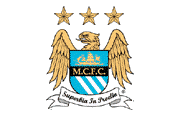
The crest was introduced in 1997 and has always been controversial (i.e. mocked) because of the stars. Usually stars like these indicate major trophies won. For instance, England have a single star on their shirts to commemorate the time they won the World Cup. Manchester City's stars, on the other hand, "constitute a design element that relate a more continental feel to the design," according to the club's official statement when the crest was unveiled. Wikipedia sheds light on this continental feel and its likely origin:
The first team to adopt a star was Juventus, who added one above their crest in 1958 to represent their tenth Serie A title. This was an extension of the existing convention by which the reigning champions are entitled to display the scudetto on their shirts for the following season. The star was later formally adopted by some organisations as a symbol for ten titles.It seems likely that the club liked the "winny" look of the stars. So (if this is right) they wanted the significance of the stars, or that the stars convey, without claiming to have literally won anything of that significance. Again, this looks like a case of 'aesthetic nonsense'. But I can imagine a City fan insisting that the stars are apt (perhaps because the team "are winners to me" or some such thing).
Brazil added three stars above their crest after winning their third World Cup in 1970. Italy did likewise in 1982. All world champions have since followed suit.
I expect that this kind of analysis of aesthetics could be (and quite possibly is) done quite widely. It wouldn't prove that people who like spoilers or City's crest-designers have bad taste. But it would allow for a case to be made that went beyond "I just don't like it."
Saturday, February 5, 2011
Philosophy and football again
I just watched Sean D. Kelly on The Colbert Report, where he says that one remaining place where the sacred can be experienced is at sporting events (he seems to include watching on TV, but perhaps only if this is with others). This reminded me of a post of mine where I talked a bit about this, but also of this essay on Liverpool Football Club and the religious devotion of its followers.
I wonder whether Kelly means that at sporting events you can feel what the sacred is like rather than actually experiencing anything genuinely sacred. That doesn't sound quite right to me (in terms of what he would say), but it's odd to talk about the sacred without being concerned with distinguishing the genuine from the fake. Colbert hints at this.
I also wonder why we laugh at everything these days, why irreverence and political incorrectness are so popular. There is even a whole genre of humour based on shock, on going into forbidden territory. Quentin Tarantino (whose films I like) comes to mind. Why do we like this stuff so much? Are we bored? Or is it somehow that if we didn't laugh we'd cry? And why is that: the death of God, the Holocaust, the failure of the 1960s hippy dream, the failure of socialism? In the words of Philip Larkin, I don't know.
It sometimes seems to have to do with the smallness of the world. I watched The Third Man last night, which contains a famous scene where people look down from a ferris wheel at the dots below and talk about how easy and tempting it might be to accept the death of one of these dots for, say, $20,000. It takes an act of imagination to see the dots as people, as mattering. This is work, and work that can cost us money. (There is a lot of money to be made in industries that a strictly ethical person might refuse to be involved with.) And you could go mad trying to take seriously the humanity of every single person that we know to be in trouble. How can you care enough about Sudan, Egypt, Iraq, Afghanistan, etc., etc.? Ethics, perhaps mere humanity, requires us to care, but sanity seems to require that we not care too much. You almost have to turn the caring on and off, and never turn it up too loud. Perhaps the kind of irony that goes with irreverence is a necessary defense of our capacity to be human. Or perhaps that's just an excuse for a moral failing, a failure to be serious enough. And sport seems more like a distraction from what really matters than an instance of it.
Anyway, I hope the Packers win tomorrow.
The closest comparison is with the Catholic Church and Islam. Both powerful religions obsessed with being big. Obsessed with the number of followers they have and obsessed with preserving their beliefs even when faced with evidence that disproves or just challenges their long-held assumptions.The last part makes me at least somewhat sympathetic to the kind of logical positivist-ish spirit of the author. The rest of it is a reminder of the humourlessness of religion. Kelly quotes Nietzsche to the effect that the sacred is what you cannot laugh at. It might be very good for there to be such things, but they ought to be things that are worth taking that seriously. Liverpool are not that, and arguably no football team is (including the Packers).
Ritual, as we know, is a key element to religious behaviour. "You'll Never Walk Alone" is an incredible example of this. It is sung with religious fervour and is about surrendering individuality for the group. It is a defining moment for all Liverpool followers. No other football chant comes close. And they ask everyone who hears it to comment on it. They ask us to confirm that it is the loudest, most awe-inspiring, most spine-tingling, most religious moment we have ever experienced. And it is repeated word-for-word, note-for-note before every match as a gospel choir would sing in church. It does not behave like a football chant. There is no humour, no taunting the opposition, no jolly lads getting ready for 90 minutes of support and abuse. It is born-again, wide-eyed fervour.
Repetition is, of course, a central factor to the belief system and that is why every Liverpool follower (I choose this word above supporter), is primed to say exactly the same as every other Liverpool follower. There can be no deviation from the true path. Have you ever met a Liverpool follower who would dare to say that YNWA is a dreadful chant or that talking about "history" is a load of bunkum? This kind of deviation is not allowed and if someone dared to say such a thing then the simple answer would be that he is not a true follower because a true follower would not say such a thing.
History. What is this fascination with history? Football is really only about the present and memory. It is not about history. Most supporters know all about their team. They know the great players, cups won and disappointments along the way. But history? This is something that religions do in order to create a back story on which to build a myth. Liverpool has no more history than Crewe Alexandra or Queens Park Rangers, although it has certainly had more success. Success can be measured and although Liverpool's followers like to quote their successes (and fear being surpassed), it is something that is ultimately too risky to build a belief system upon. In fact, this season Manchester United could become more "successful" than Liverpool in domestic league titles. For this reason Liverpool's belief system is built on an abstract concept (history) rather than something that is scientifically provable (league titles). In fact, the more Liverpool stopped winning things, the more "history" became the currency for their beliefs.
I wonder whether Kelly means that at sporting events you can feel what the sacred is like rather than actually experiencing anything genuinely sacred. That doesn't sound quite right to me (in terms of what he would say), but it's odd to talk about the sacred without being concerned with distinguishing the genuine from the fake. Colbert hints at this.
I also wonder why we laugh at everything these days, why irreverence and political incorrectness are so popular. There is even a whole genre of humour based on shock, on going into forbidden territory. Quentin Tarantino (whose films I like) comes to mind. Why do we like this stuff so much? Are we bored? Or is it somehow that if we didn't laugh we'd cry? And why is that: the death of God, the Holocaust, the failure of the 1960s hippy dream, the failure of socialism? In the words of Philip Larkin, I don't know.
It sometimes seems to have to do with the smallness of the world. I watched The Third Man last night, which contains a famous scene where people look down from a ferris wheel at the dots below and talk about how easy and tempting it might be to accept the death of one of these dots for, say, $20,000. It takes an act of imagination to see the dots as people, as mattering. This is work, and work that can cost us money. (There is a lot of money to be made in industries that a strictly ethical person might refuse to be involved with.) And you could go mad trying to take seriously the humanity of every single person that we know to be in trouble. How can you care enough about Sudan, Egypt, Iraq, Afghanistan, etc., etc.? Ethics, perhaps mere humanity, requires us to care, but sanity seems to require that we not care too much. You almost have to turn the caring on and off, and never turn it up too loud. Perhaps the kind of irony that goes with irreverence is a necessary defense of our capacity to be human. Or perhaps that's just an excuse for a moral failing, a failure to be serious enough. And sport seems more like a distraction from what really matters than an instance of it.
Anyway, I hope the Packers win tomorrow.
Monday, January 10, 2011
Philosophy football
(Not these people, who no longer seem to make a Wittgenstein t-shirt, sadly.)
Tonight the football teams that represent two great American philosophy departments square off in the Tostitos Bowl Championship Series National Championship Game (which surely needs a better name).
Oregon has cool uniforms, a team called the Ducks (a refreshing change from the usual things-that-could-beat-you-up kind of nickname), and Don S. Levi (among others).
Auburn comes from a part of the country where I think football belongs (basically the Midwest and the Deep South--is this a thought I should give up?), has a better team, and has not only individuals like Kelly Dean Jolley, James Shelley, and Reshef Agam-Segal, but also a great department all around.
So I'll be rooting for Auburn.
Tonight the football teams that represent two great American philosophy departments square off in the Tostitos Bowl Championship Series National Championship Game (which surely needs a better name).
Oregon has cool uniforms, a team called the Ducks (a refreshing change from the usual things-that-could-beat-you-up kind of nickname), and Don S. Levi (among others).
Auburn comes from a part of the country where I think football belongs (basically the Midwest and the Deep South--is this a thought I should give up?), has a better team, and has not only individuals like Kelly Dean Jolley, James Shelley, and Reshef Agam-Segal, but also a great department all around.
So I'll be rooting for Auburn.
Sunday, November 28, 2010
Elevate me
Jean Kazez says:
So how do we bring the things we care about (the Browns, the birth of a baby, etc.) together with church and/or religion? I'm not sure that a more rational form of religion is the answer. The best lack all conviction/The worst are full of passionate intensity, as Yeats said. (This seems to apply to politics as well as religion, and is almost explicitly given as a common reason for not voting for the clearly better presidential candidate in the US.) So we need to make the worst more rational (which people are constantly trying to do, without much success) and the best more passionate (which means finding something they can get passionate about).
Which is a bit like saying we need a new god, or only a god can save us now. Also like Nietzsche's madman's "I seek God, I seek God." It seems to keep being said. Which means, not to end on too much of a downer, that hope remains alive.
The good of religion It goes back to Keith Richards's book. Over and over again, he talks about the "elevation" he feels from making one out of many--one sound in a band with many members. This is a term also used by Jonathan Haidt, who references Barbara Ehrenreich's book about the lost art of dancing in the streets. We can't all be Keith Richards, but anyone can become a member of a church--and then the "band" is huge, crossing boundaries of both space and time.The second paragraph reminds me of the end of Larkin's "Church Going":
But wait--why do you need a church for that? Why isn't there sufficient elevation in going to rock concerts or political rallies or baseball games? It's different, because a church (but not a stadium) is a place in which people deal with the passage of time (marked by holidays) and the major events of life--birth, marriage, illness, death. Contingently, though not of necessity, churches are in the time/birth/death business because they are places run by priests who have contact with the powers that supposedly govern such things.
The new atheist attitude is that the whole edifice of religion should come falling down because there aren't any gods. But then you'd lose all the good. As I see it: better for religion to evolve in a rational direction, not vanish entirely. That view is the main thing that makes me a not-new atheist, and it has nothing to do with "accommodationism" about science and religion.
I wonder whoI think Kazez and Larkin are excellent on why there might be a need for church, but actually going to church does not (in my experience) provide the kind of elevation that Richards talks about. This elevation seems to come from a kind of communal art, although 'art' might be too grand a term for it. I think it would include the joy that a Cleveland Browns fan recently described to me of chanting "Asshole" in unison with a whole stadium at a hated former player. It certainly includes this kind of singing, etc. at a football/soccer match. But that has nothing to do with marriage, birth, and death. We still tend to go to church (or turn to religion in some form) for those things.
Will be the last, the very last, to seek
This place for what it was; one of the crew
That tap and jot and know what rood-lofts were?
Some ruin-bibber, randy for antique,
Or Christmas-addict, counting on a whiff
Of gown-and-bands and organ-pipes and myrrh?
Or will he be my representative,
Bored, uninformed, knowing the ghostly silt
Dispersed, yet tending to this cross of ground
Through suburb scrub because it held unspilt
So long and equably what since is found
Only in separation - marriage, and birth,
And death, and thoughts of these - for which was built
This special shell? For, though I've no idea
What this accoutred frowsty barn is worth,
It pleases me to stand in silence here;
A serious house on serious earth it is,
In whose blent air all our compulsions meet,
Are recognized, and robed as destinies.
And that much never can be obsolete,
Since someone will forever be surprising
A hunger in himself to be more serious,
And gravitating with it to this ground,
Which, he once heard, was proper to grow wise in,
If only that so many dead lie round.
So how do we bring the things we care about (the Browns, the birth of a baby, etc.) together with church and/or religion? I'm not sure that a more rational form of religion is the answer. The best lack all conviction/The worst are full of passionate intensity, as Yeats said. (This seems to apply to politics as well as religion, and is almost explicitly given as a common reason for not voting for the clearly better presidential candidate in the US.) So we need to make the worst more rational (which people are constantly trying to do, without much success) and the best more passionate (which means finding something they can get passionate about).
Which is a bit like saying we need a new god, or only a god can save us now. Also like Nietzsche's madman's "I seek God, I seek God." It seems to keep being said. Which means, not to end on too much of a downer, that hope remains alive.
Tuesday, August 3, 2010
Don't let yourself be consoled
I suppose there are exceptions, but crowds generally seem like a bad thing. Perhaps there is something to be said for transcending egoism by merging with a mass of people, but losing yourself is usually losing yourself in something, and what this is matters (it seems to me). So waving a lighter while singing along with thousands of other people to "Free Bird" or "Sunday Bloody Sunday" can't be good, even though those aren't bad songs. If you're going to give up yourself it should be for something better than that. This has something to do with integrity or honesty. Roughly: you should sing your own songs.
The idea of a non-conformist crowd is absurd. So this story about political slogans at a football match seems to miss the point. Fans holding up banners that read "The Truth Is Always Revolutionary" and "There Are No Idols" are not being political so much as absurd. Art doesn't make football political. It makes politics absurd. This in itself could be political, puncturing overinflated myths perhaps, but obscure, arty slogans are quite different from the more common, thuggish politics associated with, say, Lazio (nicknamed Nazio by some because of their fondness for fascist salutes and banners).
So I like the 'philosophical' banners as a kind of joke, but I don't expect them to change the world.
The idea of a non-conformist crowd is absurd. So this story about political slogans at a football match seems to miss the point. Fans holding up banners that read "The Truth Is Always Revolutionary" and "There Are No Idols" are not being political so much as absurd. Art doesn't make football political. It makes politics absurd. This in itself could be political, puncturing overinflated myths perhaps, but obscure, arty slogans are quite different from the more common, thuggish politics associated with, say, Lazio (nicknamed Nazio by some because of their fondness for fascist salutes and banners).
So I like the 'philosophical' banners as a kind of joke, but I don't expect them to change the world.
Thursday, July 15, 2010
Crazy Löw
I wanted to mention yesterday that I had spent a part of the morning singing to myself Van Morrison's "Crazy Love" with the name of Germany's manager (Jogi Löw) in place of the title, and that I thought he and assistant Hans-Dieter Flick looked like a cruise ship Beatles tribute band in their matching blue t-shirts and black jackets. But that would have been a bit irrelevant and I couldn't find a good picture of them. What I did find was this video, which shows Löw picking his nose and eating it. Not so nice.
Martha Nussbaum talks about the kind of disgust such acts provoke in her book, From Disgust to Humanity, which I review here and here. Her idea, backed by empirical research, is that we are disgusted by various things (cockroaches, snot, etc.) and then become disgusted by things associated with these primary objects of disgust. We might be reluctant, for instance, to lick a finger that we had seen pick a nose even if we knew the finger had been carefully washed.
Her theory about anti-gay sentiments is that they are the result of a similar kind of associative disgust: people think of gay sex in terms of unprotected anal sex (as Howell's case illustrates), feel disgust at the thought of the male body being penetrated and semen mixing with feces inside it, then project this disgust onto gay people and their relationships. Something like this does seem to be going on in Howell's email, but it is not all that is going on there, and it is not a big part of philosophical arguments against gay sex. Those arguments, after all, are designed to apply to lesbian sex, masturbation, and a range of other sexual acts that don't necessarily involve men, penetration, or feces at all. It's not as if these philosophers just say "Yuck!" and leave it at that. There is some sense of disgust in Elizabeth Anscombe's writings on sexual ethics, but there is also a strong sense that certain good things (the human body, human life, sex itself perhaps) are not properly honored by "deviant" sex. The argument is not purely a negative reaction, that is to say, but an attempt to articulate and make sense of something positive. There is much more concern with psychology and good faith in Anscombe's work than Nussbaum (who doesn't mention Anscombe, as far as I can remember) recognizes in the conservative position. Of course there are multiple conservative positions, but it's worth dealing with the best, which would surely include Anscombe's. I don't mean that Anscombe is right, but I do think that views like hers are worth getting right, and it's a shame that Nussbaum does not address them in her book.
Martha Nussbaum talks about the kind of disgust such acts provoke in her book, From Disgust to Humanity, which I review here and here. Her idea, backed by empirical research, is that we are disgusted by various things (cockroaches, snot, etc.) and then become disgusted by things associated with these primary objects of disgust. We might be reluctant, for instance, to lick a finger that we had seen pick a nose even if we knew the finger had been carefully washed.
Her theory about anti-gay sentiments is that they are the result of a similar kind of associative disgust: people think of gay sex in terms of unprotected anal sex (as Howell's case illustrates), feel disgust at the thought of the male body being penetrated and semen mixing with feces inside it, then project this disgust onto gay people and their relationships. Something like this does seem to be going on in Howell's email, but it is not all that is going on there, and it is not a big part of philosophical arguments against gay sex. Those arguments, after all, are designed to apply to lesbian sex, masturbation, and a range of other sexual acts that don't necessarily involve men, penetration, or feces at all. It's not as if these philosophers just say "Yuck!" and leave it at that. There is some sense of disgust in Elizabeth Anscombe's writings on sexual ethics, but there is also a strong sense that certain good things (the human body, human life, sex itself perhaps) are not properly honored by "deviant" sex. The argument is not purely a negative reaction, that is to say, but an attempt to articulate and make sense of something positive. There is much more concern with psychology and good faith in Anscombe's work than Nussbaum (who doesn't mention Anscombe, as far as I can remember) recognizes in the conservative position. Of course there are multiple conservative positions, but it's worth dealing with the best, which would surely include Anscombe's. I don't mean that Anscombe is right, but I do think that views like hers are worth getting right, and it's a shame that Nussbaum does not address them in her book.
Wednesday, July 14, 2010
The gays of the other
Is this stupidity or a deliberate attempt to distort the facts? The headline claims that Michael Ballack's agent called the Germany squad "a bunch of gays." This implies that he is both bigoted and hostile to the German team. But the story makes clear that in fact what happened is that he is alleged to have told a reporter which members of the squad are gay. This implies neither of those things. It certainly isn't "an anti-gay slur on the national football team," although of course the players probably didn't want his speculations about their sexuality made public.
Identifying anti-gay slurs can be tricky, as this case shows. The email in the case is here and there's discussion here. Roughly speaking, an adjunct professor of religion has been fired because he made what were taken to be anti-gay remarks. Actually he wasn't fired since he was an adjunct and you don't have to fire adjuncts--you just don't offer them another contract. No need for a good reason or anything like that. This is one reason why tenure (which still allows you to be fired if you don't do your job) is a good thing.
Anyway, responses have varied, some people thinking he did nothing wrong and others thinking it was right to let him go. But others avoid the issue of judging whether expressing his views was an act of hate speech by suggesting that he should have been fired anyway for gross incompetence. That seems unfair, since we all make mistakes (although his characterization of utilitarianism is very odd, with its emphasis on consent and all).
PZ Myers seems to get things about right to me, although I'm not convinced that Howell has in fact got Catholic doctrine right (as Myers implies). Howell writes (in his email):
The structure of the human body is probably believed to reveal God's will by some people, but it tells us little about what is and is not a proper use of the body. If one thing fits in another thing and the result feels good, how can we know whether this pleasure is sinful or blessed? We need reason or revelation, not a lesson in anatomy or health.
So we would need to consider the meaning of the human body, as Howell puts it. And this depends on the meanings of other things, such as life, death, pleasure, sex, love, and so on. Once we've figured out the meaning of life, then we can start telling consenting adults what they can and cannot do with their bodies. Of course the Church has, and is entitled to have, a view on what the meaning of life is. But this view centrally involves faith.
The giveaway is probably Howell's use of capital letters:
Identifying anti-gay slurs can be tricky, as this case shows. The email in the case is here and there's discussion here. Roughly speaking, an adjunct professor of religion has been fired because he made what were taken to be anti-gay remarks. Actually he wasn't fired since he was an adjunct and you don't have to fire adjuncts--you just don't offer them another contract. No need for a good reason or anything like that. This is one reason why tenure (which still allows you to be fired if you don't do your job) is a good thing.
Anyway, responses have varied, some people thinking he did nothing wrong and others thinking it was right to let him go. But others avoid the issue of judging whether expressing his views was an act of hate speech by suggesting that he should have been fired anyway for gross incompetence. That seems unfair, since we all make mistakes (although his characterization of utilitarianism is very odd, with its emphasis on consent and all).
PZ Myers seems to get things about right to me, although I'm not convinced that Howell has in fact got Catholic doctrine right (as Myers implies). Howell writes (in his email):
To the best of my knowledge, in a sexual relationship between two men, one of them tends to act as the "woman" while the other acts as the "man." In this scenario, homosexual men have been known to engage in certain types of actions for which their bodies are not fitted. I don't want to be too graphic so I won't go into details but a physician has told me that these acts are deleterious to the health of one or possibly both of the men. Yet, if the morality of the act is judged only by mutual consent, then there are clearly homosexual acts which are injurious to their health but which are consented to. Why are they injurious? Because they violate the meaning, structure, and (sometimes) health of the human body.Myers seems to take this to mean "If it fits, you need not quit," but 'fitted' here is not like fitted carpet. It means something more like 'right.' Which makes the reference to health irrelevant. Yes, unprotected anal sex can lead to HIV infection, but so can vaginal sex. Masturbation does not make you go blind or grow hairs on your palms, yet it is considered wrong by the Catholic Church. So what Howell's physician friend told him is really nothing to do with Catholic doctrine as I understand it.
The structure of the human body is probably believed to reveal God's will by some people, but it tells us little about what is and is not a proper use of the body. If one thing fits in another thing and the result feels good, how can we know whether this pleasure is sinful or blessed? We need reason or revelation, not a lesson in anatomy or health.
So we would need to consider the meaning of the human body, as Howell puts it. And this depends on the meanings of other things, such as life, death, pleasure, sex, love, and so on. Once we've figured out the meaning of life, then we can start telling consenting adults what they can and cannot do with their bodies. Of course the Church has, and is entitled to have, a view on what the meaning of life is. But this view centrally involves faith.
The giveaway is probably Howell's use of capital letters:
sexual acts are only appropriate for people who are complementary, not the same. How do we know this? By looking at REALITY. Men and women are complementary in their anatomy, physiology, and psychology. Men and women are not interchangeable. So, a moral sexual act has to be between persons that are fitted for that act. Consent is important but there is more than consent needed.There certainly seems to be confusion about fitting here, but the caps show that he means something other than reality. In religion, caps often function like an unintended negation sign.
Monday, July 12, 2010
Football
My friend Rick Hudson and I used to have a way to test people: ask them whether they like football (i.e. soccer). If they said Yes or No, or words to that effect, they passed. If they set off on a rant about how pointless it all is, they failed.
I thought I remembered Umberto Eco failing this test miserably in print, but googling suggests he claims to like football but not football fans (especially Liverpool fans, which is fair enough). Theodore Dalrymple seems to be trying to take this line in his essay on snobbery, which people seem to be reading and linking to, despite this bit:
How anyone can read this kind of thing is beyond me. The word 'fearful' is the linguistic equivalent of brightly coloured trousers with little animals all over them, i.e. a way to show off one's high socio-economic status that can be passed off as a joke. It's a conspiratorial "Aren't I awful?", laughing about one's own contempt for others. I'm probably missing the point or taking things too seriously, but it strikes me as smug. What's to like about that?
So is sport important? Well, it is undeniably only a game. But games are fun. How can you not like fun? They can also, as Eco and Dalrymple claim to recognise, be art. How can you not like art?
I suppose other people's seriousness always looks silly (see Schopenhauer). But you have to be a bit slow not to realize that this applies to you too, don't you? In the grand scheme of things, perhaps, nothing really matters. But that's a reason not to try to be too grand.
I thought I remembered Umberto Eco failing this test miserably in print, but googling suggests he claims to like football but not football fans (especially Liverpool fans, which is fair enough). Theodore Dalrymple seems to be trying to take this line in his essay on snobbery, which people seem to be reading and linking to, despite this bit:
I admit that, in the inner recesses of my being, I am a fearful snob. For example, I feel nothing but contempt for people for whom sport is important.
How anyone can read this kind of thing is beyond me. The word 'fearful' is the linguistic equivalent of brightly coloured trousers with little animals all over them, i.e. a way to show off one's high socio-economic status that can be passed off as a joke. It's a conspiratorial "Aren't I awful?", laughing about one's own contempt for others. I'm probably missing the point or taking things too seriously, but it strikes me as smug. What's to like about that?
So is sport important? Well, it is undeniably only a game. But games are fun. How can you not like fun? They can also, as Eco and Dalrymple claim to recognise, be art. How can you not like art?
I suppose other people's seriousness always looks silly (see Schopenhauer). But you have to be a bit slow not to realize that this applies to you too, don't you? In the grand scheme of things, perhaps, nothing really matters. But that's a reason not to try to be too grand.
Subscribe to:
Posts (Atom)