Showing posts with label dear diary. Show all posts

Tuesday, January 1, 2019

Highlights of 2018

In no particular order, here's my top ten of things I can remember from this past year:
  1. Beijing
  2. Leipzig
  3. My son got into his first choice university
  4. I read the Bible 
  5. Movies: Blackkklansman and Happy as Lazzaro
  6. Publishing four papers in four months
  7. Seeing Toots and the Maytals at Lockn
  8. TV: Babylon Berlin, Dogs of Berlin, and El Marginal
  9. I made my playlist, which turned out more or less how I wanted it.
  10. I discovered this song, which seems to have influenced two other songs I really like too:


Let's hope 2019 is as good, if not better. Happy New Year!

Monday, January 15, 2018

Nutshell studies


More about these scenes here. And, if you're wondering, these are just pictures from an exhibition I visited recently accompanied by passages of philosophy that they reminded me of. I'm not trying to make a deep point.

Friday, December 22, 2017

Year in review

Probably the most interesting thing I did this year was to decide that, now I'm 50, I should make a point of doing things that I want to do some time in my life. My mum died when she was 62 so I'm aware that I might not have much time to do these things. Or I might have several decades. So I read War and Peace, finished Crime and Punishment, and now I'm on Moby Dick. It's amazingly easy to forget that the great books really are great, and not in some obscure moral sense (although perhaps that too) but in the very simple sense of being a great pleasure to read. It's terrible that the teaching of literature seems to be done less and less, and that those who teach it seem to feel obliged to pretend there is no such thing as good and bad. Sweet Briar College looks as though it is getting rid of all its English professors, while keeping its creative writing program. Sigh.

I'm also reading more contemporary stuff, my favorites this year being Geoff Dyer's White Sands, Mohsin Hamid's Exit West, and The Rough Guide to Beijing.

I won't attempt a top ten anything of the year list, but I'm sure Lady Bird was the best film this year. Others I've seen mentioned in the same breath, like Get Out, aren't nearly as good. Get Out is certainly worth seeing, but its point seems to be to reveal a single--sort of scary, sort of funny--idea. Okja is another good one, but not that good. It's like a live action (plus CGI) Miyazaki film, but the real Miyazaki is better.

My album of the year, not that you asked, is Alvvays' Antisocialites, which is even better than their first one. Pleasant surprise of the year goes to the Granite Shore album Suspended Second, which is like the soundtrack to a really good musical, if there could be such a thing. (People say the songs sound like Abba, but they're much less disco-ey to my ear than that suggests.) Finding this Saint Etienne Christmas album was also a treat.

The other thing I need to do, of course, is to try to write some good philosophy. I will at least try this year. (Not that I haven't tried in other years, but I'm feeling a bit more inspired than I sometimes do about things I will work on next year.)

Thanks for reading. Merry Christmas and happy New Year.

Thursday, May 18, 2017

Charles S. Luck III '55 Institute Professor


Getting this was a nice way to end the semester. 

Saturday, September 13, 2014

Three days in Mexico City

I lost five pounds over ten days in Mexico, and I didn't get ill. I consumed less than I do at home, but I think most of the weight loss came from walking. Certainly I ached more than normal. So the following itinerary might not be for everyone, but it can be done. I was in the state of Veracruz for a week before I went to Mexico City, but that's somewhat off the tourist trail (although if you have a way to get around it is a fantastic place to visit) so I'll leave that part of the trip out.

Sunday: My hotel was conveniently close to the Paseo de la Reforma, a two-mile boulevard dotted with statues and very friendly to cyclists, so I walked there and then up to the cathedral and other buildings on the Zocalo (central square). It's non-stop mass on Sundays but you can go inside and look around without joining in. Outside there are people selling things and native people dancing for tourists. Then on to the Templo Mayor, and then the Diego Rivera murals at the National Palace. Chocolate and churros for lunch before heading all the way down the Paseo de la Reforma to visit the anthropological museum in Chapultepec Park. Drink 1.5 litres of hibiscus-flavored water (not as good as it sounds, but how could it be?) on the way back to the hotel. Dinner at the surprisingly not bad chain restaurant Vips.


Monday: Almost all museums are closed in Mexico City on Mondays, so it's a good day to visit Teotihuacan. I decided to book a tour there, though, and it didn't go until Tuesday, so I headed by metro to the Coyoacan area, where my guidebook describes a walk, which I did. Walked past the closed Frida Kahlo and Leon Trotsky houses, and should have had lunch in this area but instead kept walking until I reached a metro station. Headed up to the Plaza de las Tres Culturas, which involved a bit of a walk through a not very prosperous neighborhood but no one mugged me and the threatened rain stayed away. The Aztec ruins here turned out to be open (and free), which was a nice surprise. Very similar to the Templo Mayor, but without the museum. The church was closed, but for all I know it always is. Then on by metro to the Basilica of Our Lady of Guadalupe, where there was, oddly, an unsuccessful snake charmer (outside the metro, not in the church), and another mass going on. Moving walkways behind and below the priest take you past the miraculous image of the Virgin Mary. Back to Vips for lunch at dinner time, then dinner almost immediately after at a place called Hellfish.


Tuesday: Bus trip to Teotihuacan (should have gone by public transport and walked to the murals at Tepantitla). Arrived not long after the place opened, but even later in the day it was not very crowded. Spent the morning looking around and climbing pyramids, then off to taste tequila (followed by too much time in a gift shop) and eat lunch. Back in the city I visit the murals in the Palacio de Bellas Artes and have dinner at the old world-seeming Restaurante Danubio, whose walls are covered with framed cartoons and messages from, presumably, happy customers. 


Sunday, April 13, 2014

San Diego

I'm going to the Pacific Division Meeting of the APA this week, so blogging might be light (or heavy or exactly the same). Is there anything I should make a point of seeing? I haven't read the whole program yet, but a quick search showed that the session I would most like to attend clashes with the one I'm part of. Oh well.

In other news, my book appears to be out now. At least I got my copies on Friday, so I assume others are available. Hooray.

Tuesday, January 14, 2014

Josh on music

Several memorable thoughts on music over at josh blog recently:
I don't like going to philosophy conferences, but I like it less when I'm frustrated enough to lose sight of why they're dissatisfying. One way of putting it: however little it makes sense or however obscure it is to think this, I somehow see artworks as having the same standing as works of philosophy; or, art as having the same standing as philosophy. I have a fantasy of beginning a paper-reading session at a conference like this by playing a piece of music—giving the audience a chance to listen and then displaying an attempt to put into words what is heard, giving a demonstration of the fact that there are phenomena in life with the structure of calling-for-articulation. The difficulty of putting things to words seems to get short shrift among philosophers.
All of this is worth reading, too, albeit hard to talk about.

And finally this: I used to prefer 'Protection'. Now I prefer 'Safe From Harm'.

Thankfully we don't have to choose, Although I wish foreign policy were directed by someone with the hardly extraordinary insight of whoever wrote the words to 'Safe From Harm' (i.e. people don't always like being 'liberated'). 

Predictably all I got from josh's recommendations was the discovery of Kacey Musgraves, by far the safest music on his list. I don't think of myself as liking country music at all (except when it's done by non-Americans), but I like this. Perhaps because it sounds a little like Mary Lou Lord (not this song, really, but others). 

I don't have much to recommend in return, but I liked Tracey Thorn's autobiography a lot. I think of this blog as a diary as much as anything else, so even if it's of interest to no one but me let me record that it was nice to read something that felt as though it came from my world. I'd forgotten that was a world and not just me. (Not that her world is quite the same as mine: there are regional, age, and gender differences that matter, as well as some differences of taste. And I never became a pop star.) But if you like 'Protection' enough to want to know more about its singer then you might want to know that she's written a good book.  

Wednesday, January 1, 2014

Happy New Year


New Year's Resolution: to write something of value.

Thursday, November 21, 2013

World Philosophy Day

Today! Who knew?
Celebrated every year on the third Thursday of November, the World Philosophy Day will be held in 2013 on Thursday, 21 November. The day after the closure of the 37th session of the General Conference of UNESCO, the celebration will be a unique opportunity to reflect on the greatest contemporary challenge, to which UNESCO and the entire United Nations system seeks to respond, namely: building inclusive societies on a sustainable planet.

Celebrated on 21 November 2013, the 11th edition of the World Philosophy Day will be an opportunity to organize, on all continents, various events under the general theme of the 2013 World Philosophy Day “Inclusive Societies, Sustainable Planet”. They will enable their participants to share a multitude of views and experiences, fully respecting cultural diversity. 
This seems worthy, but I'm not sure how philosophical it is. There is more to philosophy than letting people share their views and experiences, after all, although perhaps no one is confused about that. I hope it's productive.  

Thursday, June 6, 2013

Six days in Hong Kong

If you're going to Hong Kong for a short visit, my first advice is: don't buy the Lonely Planet guide. The map is useful, but you can print out maps from the internet. Its advice is pretty bad. For instance, in the first few pages of the book it lists eleven "top sights" (pp. 8-11) and suggests a four-day itinerary of Hong Kong's "must-sees" (pp. 14-15). Do the must-sees include all the top sights? Nope. Do they include shopping at the same place (G.O.D. in Causeway Bay) twice? Yep. Do they include one full afternoon and two part-afternoons of shopping on a four-day, probably once-in-a-lifetime trip? Yes. Is the only suggested alternative visiting a temple that you are supposed to have already seen? Naturally. Is that temple actually worth visiting? Not unless you want to be among busloads of tourists. It seems to be a sort of Taoist Lourdes, and it has zero charm for anyone not hoping for a cure. I won't go on, but I could.

Probably the best place I saw in my six days in Hong Kong is the Ten Thousand Buddhas Monastery. As far as I can tell this place is not even mentioned in the Lonely Planet book, which is a disgrace. Let me qualify these last two sentences: although I was a first-time visitor on a short trip, I was with a friend who lived here for a year, and who took advice from Hong Kongers about what to see when here. He and his wife gave me invaluable suggestions about where to go (insert joke here) and they described the Ten Thousand Buddhas as a must-see. In short, I have more Hong Kong tourism expertise than you might think. Second qualification: the monastery is a very long way from being wheelchair accessible, involving a steep climb up a hill. There is a ramp, but I cannot imagine having the arm-strength to get a wheelchair up it. And no one who struggles up hills could walk it. The incline is about 30 degrees, I would guess, and it lasts and lasts. But if you can get there, it is well worth it.

The view's not bad, for one thing.

My second favorite temple is not the famous Man Mo Temple in Sheung Wan, although that is very good, but the more out-of-the-way Man Mo Temple in Tai Po. I was in Tai Po anyway because it's where my friends lived, but it might not be so much better than the other one to justify a trip out there. Your call. The famous one is bigger and, I'm told, often filled with tourists (I saw only a few when I was there). The more obscure one is a bit smaller and much quieter, hence more atmospheric. Both are fantastically elaborate: lined with statues of multiple gods, colorfully painted, intricately carved, filled with incense, punctuated with drum beats and bell tolls, occupied by the genuinely devout, places of commemoration hanging with flags of prayer, places for giving gifts of food and more incense to the gods, enemies of minimalism, sullied by my photographing presence. 

The cones are suspended, burning coils of incense.

Other highlights so far: the view from the peak (clear when I went there, but perhaps not a must-see otherwise), the Star Ferry between central Hong Kong island and the Kowloon Peninsula, the Hong Kong Museum of History (lots of short movies and life-size replicas you can walk through and around, all for less than US $2: a must), the Hong Kong Museum of Art (a should more than a must, but also less than US $2 and right next to the Tsim Sha Tsui Promenade, so you really should), and Kowloon Park (Hong Kong Park is meant to be nice too--both have aviaries, people doing Tai Chi, etc.). 

The second best thing I did was to take a free Tai Chi lesson on the promenade from William Ng and Pandora Wu. You just show up at 8:00 am on Monday, Wednesday, or Friday and join in. I found out about this from the Lonely Planet guide, so it's good for something, but it incorrectly says that you have to make reservations. Far from it--any passerby is loudly encouraged to join in. I showed up early and found myself doing twenty minutes of Tai Chi (very badly) with Chinese people (some of whom were just as bad as me, thankfully). The lesson starts with breathing exercises, about a minute of meditation, watching a demonstration, being led through a short routine of exercises a few times, watching another demonstration, and then finally photographs. Unfortunately they kindly insist on your being in the pictures with them, and in a Tai Chi pose no less, so I won't post one here. But they are expert teachers, the location is spectacular (when you're not watching the instructor or keeping your eyes on your left hand as instructed all you see is the harbor and the skyline behind it), and it's a perfect introduction to one aspect of Chinese religion and culture. 

The third best thing I did was go to the Big Buddha (I just mis-typed that as Big Buggha!) on Lantau Island.  It's quite touristy, but you can just walk through those parts and focus on the 34-metre-tall Buddha, the weird vegetarian lunch (including unidentifiable-vegetable soup) you get at the nearby monastery if you buy a ticket to see the relic and view from upstairs in the Buddha building, and the great walks you can do up there away from the crowds. I had already checked out of my hotel and wanted to avoid getting too sweaty before my flight home, so I didn't hike much, but I did walk the Wisdom Path. I had no idea what this was, but it turned out to be all 260 verses of the Heart Sutra (in Chinese) inscribed on huge wooden columns in a figure-eight pattern. It reminded me of Stonehenge, although I suppose I'd be getting carried away if I said it was as impressive a sight as that. Still I think the Hong Kong Tourism Commission is right to call it a masterpiece.

Sadly, the same cannot be said of my photograph.

Other places I've been:
  • the mid-level escalators on Hong Kong island: outdoor escalators going up (but not down) a steep hill surrounded by real-estate agents and bars for ex-pat Brits, Aussies, etc. All I could think about was the lives those people must lead. They must be loaded because it's an expensive place, but they all seem to be either together (not mixing with the natives) or alone (not mixing even with each other). Analytic it may be, but island life looks insular for ex-pats. And clichéd it may be, but are they really happy?
  • Temple Street Night Market: surprisingly similar to markets in Cambodia, almost as if there are factories in Asia churning out all those Buddha statues, Dr Dre Beats headphones, etc. Until we got to the sex toys. Those were new. And very, very plentiful. 
  • Chi Lin Nunnery and adjacent Nan Lian Garden: more restrained than the Taoist temples but still not all that different really, and very peaceful
  • Hung Shing Temple and Fook Tak Temple: both recommended as among the "best temples" by my guidebook, neither worth going out of your way for given their small size. The book calls them "quirky," but there just isn't much there to see except people trying to smoke a cigarette or pray and being interrupted by some fool with a camera who bought the wrong guidebook  
  • Cheung Hing Tailor, fourth floor, 79 Queen's Road C. [Central?]: bought a custom-made jacket (which hasn't arrived yet so I can't vouch for the quality, but others who should know do). About $140 including shipping, which seems like a good deal to me. Quite an experience too: "Two button free button? New fashion! Two button. Obama! Ha ha!" 
Here's the itinerary I would suggest:

Day One: maybe the first morning you should walk around Tsim Sha Tsui (I'm sort of assuming you're staying in this area, just because I did), visiting the promenade (don't miss the Tai Chi lesson at 8:00 if it's Monday, Wednesday, or Friday), the history museum, and the art museum. After lunch head for the peak if it's clear, or a temple if it's not. Maybe take the Star Ferry to central and hit Man Mo Temple, see some skyscrapers, and pretend to be in the market for antiques. There really is a lot of good shopping to do, from expensive works of art in central to cheap (not-necessarily)-crap in the night market.

Day Two: if you are sufficiently mobile, head to the Ten Thousand Buddhas Monastery in Sha Tin. You could visit the Chi Lin Nunnery and adjacent Nan Lian Garden in the afternoon. There is a restaurant here (which I didn't try), so perhaps go here in the morning and then hit the Ten Thousand Buddhas after lunch, although I tried something like this and didn't stay long enough to still be in the garden at lunch time. Your patience may vary.  

Day Three: head out to Lantau Island (the MTR train system takes you to Tung Chung, then you get a cable car to the Big Buddha). I would seriously consider making a day of this, either hiking as much as you can or doing one of the tours of the island (one includes a boat trip on which you might see dolphins). For about $10 (US) you can go up in the building at the base of the Buddha, where there is an unimpressive museum and spectacular views, and an enormous vegetarian lunch down below at the monastery. Worth it, I think. 

Days Four-Six: catch up on whatever you missed that I mention above, otherwise see as many temples as you can, walk as much as you can, and look around some markets. If I had stayed longer I might have gone by boat to Macau, which sounds good.

A note on food: Maybe it's just me, but I often felt inclined to skip lunch, which is not the usual me at all. My hotel offered a huge buffet breakfast, dinners were very filling, and there is plenty of snack food available as you go around (the English-style custard tarts are great, there is good dim sum in the markets, and I would try as many mysterious dessert-type things as you can). So that leaves dinner. You have to have dim sum at least once. The best other food I had was hot pot (not sure where, but it felt like a very local place) and meals at the Spicy Crab (which gets remarkably mixed reviews: I had nothing very expensive there and it was all very tasty, perhaps because I went with people who knew what to order) and (I think) Lin Heung Tea House. The hot pot can be spicy if you want (you get to choose the broth you cook your food in, and to add whatever spices you like to your own bowl), and the food at the other places was sometimes incredibly garlicky (which I like). People here don't generally speak much English, but it's not that hard to find places with menus in both Chinese and English, and you can point to what you want. Or stick to sad pub meals in Central.

This is worth seeing too.


Thursday, May 30, 2013

Cambodia part IV: Sihanoukville

I'll keep this brief (although that's what I thought last time). Not being much of a beach person, I was not really looking froward to Sihanoukville. And when I got there it seemed like a dump: the town has no real history (it wasn't founded until 1960), lots of trash, no museum that I could detect, drunk/stoned tourists, the least good of all the hotels we stayed at (I couldn't find a fork at breakfast the first morning, let alone a mango--the horror!), and the first thing of note I saw at the beach was this:

I don't want to think what happened to its head.

But I kept walking. After an hour I could only keep going by walking away from the beach and onto a road, so I headed back. It turned out I was only yards away from Otres beach, where you can buy loose joints for $1.50 (I didn't) and live out your fantasy of reading sacred Indian texts in a hammock (I did, albeit for only about two minutes).

Vedas and (Walmart) Tevas.

On that first day I also visited Wat Krom, which is worth a visit and increased my rating of the place. 

The next day I headed out to Ream National Park. A nice combination of boat trip, wildlife (mostly birds), jungle trek, and beach. Better was the next day, when we went to Otres. And best of all was the last day, when we took another boat to visit three islands, which was like the Ream trip but with less wildlife and more beach, but also better beaches, a more interesting boat ride, and snorkeling. If you've never snorkeled, take your glasses off and swallow some salty water. You're welcome.

Some people jumped off the top of this boat into the Gulf of Thailand. Others dropped hesitantly while wearing a life-jacket. I won't say which category I was in, but it wasn't the former.

In short, Sihanoukville is worth visiting after all. If you have just one day do the trip to Bamboo Island. If you have two, go to Otres beach as well. If three, hit Ream National Park. And visit a wat (temple) or two in your spare time. 

Tuesday, May 28, 2013

Cambodia part III: the homestay

After Phnom Penh but before Siem Reap we stayed in a small village. Apparently doing a homestay, i.e. staying in someone's home to get a taste of real life in the country, is a thing. We were scheduled to do it for four nights, though, which I'm told is longer than most people do. I have to be careful how I describe it because if I make it sound too tough I will insult our hosts, including (I think) the son or sons who paid for the house we stayed in for their mother, and if I make it sound too easy I will insult the people in our party who struggled to last four nights there. Tricky.

Here's what the place was like. The village (I don't know its name) is part of the Kien Sangker commune (group of villages) and is poor. A bit of googling suggests that:
Kien Sangker [is] one of the poorest regions in Cambodia. This commune is made up of 12 surrounding villages and the families in this region survive on average monthly income of US$15-$30 per month. Around 80% of the population live in poverty with around 45% living in extreme poverty.  
Most people here seem to live in one-room houses made of wood and palm fronds, lifted off the ground by stilts, perhaps to keep unwanted animals out. Many houses in Cambodia are high enough off the ground that people and animals can shelter beneath them from the sun. It's a good place for a pallet or hammock to rest in. But some are raised only a few feet up. We had access to a hole-in-the-ground outdoor toilet (flushed by pouring bowls of water from an open tank into it), but I don't know what most people do. Maybe the same thing. Water is stored outside in big concrete barrels (in our case) or, more commonly, in what I think of as Chinese-style water containers.

They look Chinese to me, anyway.

One of the people in the house next door wore what you might (but shouldn't) think of as a "coolie hat." Some etymology, which seems apt:
Coolie is derived from the Hindi word kuli (क़ुली).[4] [...] An alternative etymological explanation is that the word came from the Urdu qulÄ« (क़ुली, قلی), which itself could be from the Turkish word for slave, qul.[4] The word was used in this sense for labourers from India, China, and East Asia. [...]
The Chinese word è‹¦ åŠ› (pinyin: kÇ”lì) literally means "bitterly hard (use of) strength", in the Mandarin pronunciation. In Cantonese, the term is å’• å–± (Jyutping: Gu lei). The word refers to an Asian slave.
These people are not slaves, but some do live bitterly hard lives. This is the house next to the one we stayed in:


Most of the other houses were similar to or less impressive than this, and they were grouped around a deep and very dry pit for water (the rainy season hadn't begun yet and the summer was unusually hot) and dry rice fields. There were a few cows, chickens, and pigs too. Also coconut and banana trees, and traps involving water and plastic sheets to catch crickets. At sunset hundreds of bats would drop out of one of the trees like an army of Jacques Cousteaus and fly off in search of mosquitoes. There are also beetles and cockroaches, large spiders (some poisonous), and lots of small lizards. It's a lively place.

Almost time for the bats to start dropping.

We experienced the same heat as the locals (although we had fans in our bedroom, while many of them slept outside), the same washing facilities (pouring bowls of water over yourself outside by a large tank, which is very refreshing but not so great for getting your feet clean (you are standing on dirt, after all) nor for cleaning anything that is covered by whatever clothing you are wearing (you are outside in a public place, after all), although we also had the option to wash inside in private on a tiled floor--something we chose not to do for fear we would get the floor too wet (although it is designed to drain away water) and messy, and did stay in a real village house, albeit by far the nicest one in the village. But we ate extremely well, having a team of people cook and bring us food, including the best pancakes I've ever tasted. We had clean, bottled water to drink. We slept under mosquito nets. We had people on hand to remove the occasional scary spider or bat that got into our room. They always did so with care not to harm the animals, which impressed me--rather than kill it our guide even caught a bee and opened the door on a moving bus to release it, although he is not a vegetarian, and vegetarianism seems barely understood here. I did meet a Cambodian ex-vegan, but she had given it up on doctor's orders because she was losing so much weight. As far as I could tell she just needed more protein in her diet, but perhaps there was more to it than that. Vegetarian meals here (they are easily available in tourist places) often contain only rice and vegetables, no tofu or nuts, for instance. No wonder it's not a popular option. Anyway, we had several dishes at every meal, with pescetarian options as requested, and unlimited quantities. Fresh fruit for dessert too. We were living in relative luxury among people who live in real poverty.

Our temporary home, with bug-prone-when-lighted dining area to the side.

So what was hard about it? Not guilt, as you might think. And not everyone found it all that hard. Those who did were suffering from sleeplessness from the heat (although most nights it got cool enough that at some point I would wake up and pull a sheet over myself), homesickness, distraction by bugs (some of which would get inside your mosquito net if you weren't careful), and diarrhea. Never getting completely clean was also an issue. And I think the mood of suffering was somewhat contagious. There was also a bereavement. We ended up staying only three nights, at least partly because the students I was with were supposed to be writing and they had a hard time writing in these circumstances. It certainly gave them something to write about though.  

How authentic was it? Closing your eyes doesn't teach you what it's like to be blind. But it's better than nothing. And in some ways we had it tougher than the woman who lives in the house when people like us aren't kicking her out. She has a bed, we slept on mattresses on the floor. She has her own room with a TV. We slept twelve to a room, with no TV. She presumably uses her indoor bathroom, we used only the toilet. But really we still have no idea what life is like in these villages. Or perhaps we know what it is like, but not what it is. We can describe it, but can't seriously claim acquaintance with it. Just as well.

Our time was spent oddly. Originally we were scheduled to work six hours a day renovating the toilets at the school at the local monastery. That changed quickly when the work began (breaking up concrete with hammers, scraping off paint with wire brushes), but perhaps because there wasn't really that much to do rather than because we were wimps. We ended up working three hours the first morning, about four the next (our early start did not bring the early finish we had hoped for) and maybe one at most the third day. It was somewhat deflating to see that the real work crew had used electric sanders on the paint in our absence. Why did we have to do it the hard way? But they surely wanted to use as little of the gas used to power the sanders as possible. Still we weren't sure that our help really helped, given that we had to be trained in each new task and never got to be as good as the pros. Did they think we wanted to be doing manual labor in 100 degree heat? Perhaps we did. It was somewhat satisfying. But I think the most help we provided was financial. 

(Some people do want to do manual labor because it's service learning, even if it's more learning (and learning what, in these cases, exactly?) than service. But that wasn't why we were there. People also want to help. I met a woman who paid to volunteer at an orphanage, and then found out that there were far more adults working there than was necessary. Perhaps the money she paid helped. Or perhaps it was just a scam (some orphanages in Cambodia are not really orphanages at all). You have to be careful. At least you do if you want your money and efforts to go where they are most needed. Even being scammed contributes to the economy, and God knows it needs contributions.)

Although I've never been on a cruise our afternoons reminded me of shore excursions from a cruise ship. One day we learned how to meditate in the temple across from the school. 

This pagoda is fifteen years old. They are still building them like this.

The next we visited a "floating" village, i.e. one whose houses are on extra tall stilts because when the rains come the Tonlé Sap lake floods the village. There is at least one village that actually floats on the lake, but this wasn't it. In fact we never saw the lake at all.    

Not so much floating as dusty.

On the third afternoon we butchered learned traditional Khmer dancing.

Now you try.

It's obviously not real when your meditation teacher is a gold-medal winner (yes, they give medals for meditation!--photographs of the award ceremony decorated his proud mother's house) who takes time off from his job in the city to give you a lesson, or when a huge sound system is set up and dancers brought in for a special performance and lesson. On the other hand, these are real people doing real things. What else could they be? And there were no other tourists around, which I think is sometimes the implicit definition of 'authentic.' However canned, it was reality. Served up on a silver platter, of course, but I'm not complaining about that. For an extra dash of reality, how's this? Later in Siem Reap a dance troupe we happened upon in the market included the young woman from the trio who taught us out in the countryside. And the audience in the market contained as many Khmer people as barang. Canned in a way, but no silver platter this time. And some of the same dances we had a go at ourselves. 

Maybe it's real if you end up covered in sweat and paint dust, as we did. Or if you feel the need to quit a day early and head for a cushy hotel in Siem Reap. Or maybe quitting makes it all no longer real at all. Reality becomes a question of values rather than metaphysics. But it's a question I'd rather not ask at all, however forcefully a homestay experience might push it at you.

Friday, May 24, 2013

Cambodia part II: Siem Reap

The most obvious reason to go to Cambodia is to see the temples in the Angkor Archaeological Park (it's not just Angkor Wat, you know), and the place to stay then is Siem Reap. The name translates roughly as Fuck Off Thailand, or Thailand (Siam) Defeated, if you want to be a bit more literal. It's a tourist town, and has been cleaned up quite a bit in order to attract foreign dollars. (You actually do pay for things here in US currency, although it's all coin-free, so small change is given in Khmer notes. 1000 riel = 25 cents.) Hardly any children begging on the streets, for instance. It can be hard to remember not to give to or buy from children who ought to be in school, especially since they sometimes follow you around as you visit a temple, asking your name, where you are from, etc. But it's not good to incentivize truancy. In Phnom Penh I was kicked by one child when I refused to give money to the woman he was with, but nothing like that happened in Siem Reap. The way to help these kids is to do what you can to support the better NGOs, like Green Gecko. There are several restaurants and shops that support projects like this, so you can eat well and shop while doing good. And then you can visit the temples (where you can also give to the bands of landmine victims that play there.)
The view from my hotel room when I first arrived in Siem Reap

To see enough I think you need three days here, and more would be better. The best temples are at Angkor Thom (a complex of temples and terraces, including the famous Bayon), Ta Prohm, and Angkor Wat. You can see all these in one day. I did, although my visit to Angkor Thom was a bit rushed. There's also a "big circuit" of slightly less good temples that you can also do in one day. And then there are various places not too far that you will probably also want to visit, like the River of a Thousand Lingas (which I saw--not too far from the lingas is a waterfall with a pool you can swim in, where little (and some not so little) fish nibble off your dead skin, which can be an unwelcome surprise when you don't see them coming, but it grows on you) and Beng Mealea (which I didn't see). You can definitely burn out on these temples, which are often similar to each other and crawling with tourists trying to spoil your pictures. But I regret not seeing every one that I missed. So it's wise to take your time, take breaks, and see as many of them as you can. From my hotel I paid $15 total to be driven to the park, around the big circuit with as many stops as I wanted for as long as I wanted, and back again. A ticket to get into the park costs extra.

Damn kids ruin my shot of the lingas

The weird thing about these temples is that you can just climb all over them. In fact you have to, to some extent, to get around. So you'll stumble, put out your hand to stop yourself falling over, and realize that your hand is on, and damaging, a thousand-year-old world heritage site. In a few places entrance is not permitted, but I saw whole tour groups push and squeeze past the signs telling them to keep out so that they could get a good look and take their pictures. The thoughts you have during your visit are these:

  • That might make a good picture
  • I am the love child of Indiana Jones and Lara Croft
  • Man, it's hot
  • I wish these other people would go away, or at least move off camera
  • I should focus more on what is around me and less on taking pictures
  • Wow, there was a huge and very sophisticated civilization here a thousand years ago in the fricking jungle. How did they do it? What was it like? Why don't I know more about it?
  • Elephant statue! I love elephants. Must get my camera out.
It's probably a good idea to have a guide or a guidebook that you actually read there and then so that you don't just take pictures and leave. But you can always read up before and after. Another good idea is not to focus only on the best temples. The others are very nearly as good, and are less crowded, which makes for just as good an overall experience. 

Elephant statue!

Between temple visits you can see the sights of Siem Reap. It's mostly bars and t-shirts, with the odd massage parlor thrown in as well. But you have to get some souvenirs (five t-shirts for $10! who cares if I don't need any more t-shirts!), the massages are good value (traditional Khmer is only $6 in the hotel, $3 in the market, and it's both invigorating (i.e. painful) and awkwardness-free (you are fully dressed throughout)), and you've got to eat. Two other things to see are the Angkor National Museum and Artisans d'Angkor. The museum is relatively expensive ($12, and that's without the audio tour, in a country where you can buy five t-shirts for $10 (as I might have mentioned) and dinner for $3) and a bit falling apart, despite looking very new. It's not that the place is falling down, but some electronic equipment is either missing or broken, and I didn't get the movie I was expecting of sunrise at Angkor Wat (although there was some underwhelming, sped up thing that might have been it). That said, I think this place is a must-see. I spent two or three hours there. For me it provided exactly the right amount of background on history and religion to appreciate the temples more (of course other people will want more or less). You also get to stop and look at statues and carvings in a way that you aren't likely to at the temples themselves. The best time to go might be between temple visits. That way you will recognize some things and have them explained to you, while picking up new knowledge to enhance your future temple visits. I just went before I saw any temples, and forgot more than I would have liked. Artisans d'Angkor is free, although of course you exit through the gift shop. Once you've found it (down a side street and then an alley) you get a free guided tour around a series of workshops where people make statues, scarves, etc., to sell to tourists. Not my kind of thing, really (I don't like crafts or going behind the scenes of anything), but my guide was very friendly (something that applies to all Khmer people, if I can essentialize for a moment) and the tour was quick. The cool thing is that these are the people who are called in if something at one of the temples needs to be replaced or repaired. They are also lifted out of poverty by working for this group. So you ought to buy things in the expensive shop, but I didn't. 

There are four kinds of prices in Cambodia:
  1. The price for locals
  2. Cheap prices for tourists (five t-shirts for $10, scarves for $1 each at the market)
  3. Mid-range prices for tourists ($10-$20 for a scarf, say, at an NGO-related store)
  4. Expensive prices for tourists ($100 for a scarf at the National Museum or Artisans d'Angkor, say) 
Probably everyone should pay the high prices, but I couldn't bring myself to do it. I don't have Angelina Jolie's budget. And I didn't see many other people doing it either. So I think some of these prices, at least in the museum gift store, will have to come down, even if they are only what they would be in other countries. I stuck with options 2 and 3, although my friend bought a nice piece of art for under $40 at Artisans d'Angkor, which isn't bad. 

Since I've descended into talking about shopping I should stop. This is what Siem Reap is like though. You come for the temples and a sense of wonder, you spend your time bargaining, looking for bargains, or avoiding people offering you bargains. It is great though.

That's a circular rainbow around the sun.

Wednesday, May 22, 2013

Cambodia part I: Phnom Penh

The first thing I have to say about Cambodia is that you should go if you can. The second thing is that if you go you should try to use Buffalo Tours. The country is fantastic: very different from the world I'm used to and just like somewhere Tin Tin would have an adventure. (Of course that raises questions about my relation to the exotic, but perhaps being here will reduce any corruption in my soul that there might be of the colonialist kind.) Our guides have been incredibly friendly and helpful, and the itinerary has been designed in such a way that we see very few (other) tourists and have experiences like a private lesson in traditional Khmer dancing on the grounds of a rural monastery as opposed to the more obviously touristy experience of going to a Vegas-style show of Khmer dancing. I think the idea of discovering the real Cambodia is something of a myth (there is no real world, as Tracey Thorn says), but we've come much closer to the mythical ideal than most visitors do. What follows is going to be a cross between a diary entry and advice for other travelers. I'm traveling with a friend and a group of his students, so technically I'm not a tourist. But I am touring. And I'm not, so far, having to do a lot of work.

Phnom Penh is not very popular with tourists, at least not compared with Siem Reap. But I loved it. The people are poor, but they don't seem to be starving in the cities. It seems at times like an economist's fantasy: literal markets are all over the place, and every street seems to be lined with small businesses, open till long after dark (although it gets dark fairly early here). Even in the country, where poverty is more severe, I saw one street lined with beggars too old or too young to work on the farm, and so getting money the best way they could. And they do get money, because the local people believe that if they give to beggars they will get good karma. So the spiritual economy helps the earthly one. Most country roads are not like this, but this particular one leads to a monastery, so it must get a lot of Buddhist traffic. 

These monasteries are everywhere too, about as common as churches in Europe. Typically they seem to be like small villages, with an outer wall, impressive entrance, magnificent pagoda or temple, a dining hall for the monks (serving breakfast and lunch only), and various other buildings for the monks to sleep in, perhaps a graveyard, a school, etc. Being a monk or nun is not necessarily for life, and access to education (and food) seems to be a big motivator. The man who gave me a lesson in meditation spent seventeen years as a monk but is now getting his MBA so that he can earn money to help his family. This is all part of his life plan, and monkhood was the key to his getting the education he wanted. When I asked him what monks did all day when they aren't meditating he said they study: Pali, Cambodian literature, English, etc. 


A typical rural scene: dirt road, cow, ornate religious buildings.

Here's how to meditate. (Warning: no big surprises ahead, although the very simplicity of it all kind of surprised me.) Sit with your right foot on your left knee, or thereabouts, and your right hand palm up on your left hand (also palm up). Keep your back straight. Close your eyes. Do not let your mind leap about like a monkey. Instead focus on what you are doing: I am sitting, I am breathing in, I am breathing out. Breathe slowly. That's it. You can also do it lying down, a position I found much easier to attain. Getting my legs into the sitting position was like trying to refold a map that's been creased wrong. Why do this? To train the mind not to want so much, to achieve liberation from incessant desire. The mind is like a cow and will follow its own path unless trained to go where you want it to go. Meditation is the training that would stop someone like Bill Gates from always wanting to have more wealth. (The ex-monk's examples, which I like partly because the choice of animals gives you a sense of the country. There are lots of humped, white cows and a fair number of wild macaques in Cambodia.) I can see the appeal of this in a poor country, but also the political convenience of it. It's not hard to imagine kings liking a religion that encourages acceptance of one's lot among the peasants, and that promises rewards in future lives. I suppose getting rid of all this superstition is one of the things the Khmer Rouge wanted to do. 


It didn't work out so well.  

Of course we have similar things in the West, but it's either more blatant in Cambodia or else just easier to see it when it's not your culture. Not that religion is all just superstition. There's nothing superstitious about the kind of meditation I was taught: it works or it doesn't, and both cause and effect belong to this world. And I doubt it's simply that a non-superstitious teaching or core is covered by a popular web of superstition. The sleeping  lying down meditation is done with your head toward the Buddha, feet away. This is out of respect, not superstition, but it isn't anything to do with cause and effect. There's an elusive ethical area between worldly calculation (means-end reasoning) and supernatural bargaining (superstition). I like the fact that so many schools literally occupy the area between the pagoda and the market, but within the walls of the monastery. Schools should be closer to temples than marketplaces.

A young monk (most of the ones here looked to be of school age, which is largely why they are here) heads into the temple. The school is just off to the right.

Within the city there are monasteries too, and lots of markets. I have no night pictures, but I have vivid, almost nightmarish memories of coming across a crowded, moon-related celebration at a small shrine one evening, across the street from a small market where piles of fried tarantulas and other bugs were sold. We were not at the Foreign Correspondents' Club any more. Another time I wandered into a monastery and was led by a limping monk (one of his feet was at about ninety degrees to the other) to a locked, low, dark chamber, where I sat sweating before a gold Buddha with an electric, technicolor halo, while another man repeated "Ounalom Temple. Eyebrow Buddha," to me and my friend, pointing at the Buddha's monobrow and sensing our incomprehension. We bowed as if we knew what we were doing (I think he was laughing, at least at me), offered our incense sticks to the Buddha, and accepted a water blessing. Then the man indicated that we should leave money for the Buddha and, when we got back into daylight, the limping monk asked how much we gave. Had the ounalom business been hocus pocus designed to get our money? There was no knowing. Until we got on the internet and found that it's a genuinely old monastery said to house a hair from the eyebrow of the Buddha. Not a scam, in other words. And yet still really a scam, I suppose. The relic isn't likely to be real, and venerating it is nothing to do with non-Buddhists like me. Also prices should be advertised upfront. But that's the wrong kind of thinking for this kind of occasion. You have to let go of your usual mindset. Or at least relax it a little. Open up. It's like a mental massage.

Gateway to Ounalom.

There is something to be said for wandering around, in other words. At least if you want to feel as if you're in a 1930s adventure story, or on LSD (in a down-the-rabbit-hole-but-not-quite-sure-this-was-a-good-idea kind of way). It is a mind-altering experience. The smells are different from the smells at home. Often for the worse (there's a sewagey smell that I can't identify (stagnant water, perhaps), and I saw an average of one man or boy pissing by the side of the street for the first few days of the trip), but then the better smells are all the more welcome and heady: jasmine from a garden or on a stick to give to the Buddha, and incense burning for the Buddha. The sounds are different too. Loud music plays in public at odd hours of the day, sometimes sounding Indian, sometimes Chinese, sometimes Arabic, usually Cambodian. There are bands that play in temples and bands of landmine victims that play for tourists outside ruined temples, and my hotel in Siem Reap seems to pipe in this sound, even to the point of waking me up with it. No one seems to think that music is anti-social. And I suppose it isn't. 

The sights are different, of course. The landscape is mostly flat, made up of rice fields (mostly dry), red dirt roads, stilted houses (usually made of wood and palm fronds, often hosting advertisements for beer), and spiked with sugar palm trees. There are geckos on the walls and ceiling (especially in the Foreign Correspondents' Club, where the food is bland and expensive), dogs everywhere (all the same breed and size: medium), a fair amount of garbage (mostly tied neatly in carrier bags), not many buildings more than two or three storeys high, temples, lots of motorcycles and tuk-tuks, and lots and lots of people selling things, or wishing they could sell things, or sleeping off the heat, or begging, often with small children or landmine injuries. Your heart might bleed or break if your mind wasn't so busy exploding, or just trying to process everything. And the signs are all hopeful: surely the economy will grow now the war is over, and surely tourists will flock here in flocks (why did I nearly say droves?). Signs can mislead though. The government is not all it might be, and if anything holds this country back it will surely be corruption. 

Poverty and prosperity side by side. There is more poverty though. By far.

The tastes are different too. The national dish is fish amok, which is a curry made with coconut milk and banana leaves. The combination of seafood, curry, and tropical sweetness pretty much hits all my buttons. In general the food is both like Thai food (and therefore good) and unique (and therefore interesting). There's a lot of rice, a lot of (pretty mild) curry, a lot of stir-frying, and a lot of unfamiliar ingredients (the mysterious and ubiquitous "river fish," morning glory, dragon fruit, etc.). The mangoes are double good. Of course it isn't all great, but it's all been at least OK. 

And even the feel of the place is different. It is hotter than Virginia, and so very sweaty. An Englishman I met told me that even the Cambodians say this is the hottest summer they can remember. So it's not surprising that for people with money there are all kinds of delightful ways to cool down. Every time I enter the hotel lobby I'm given a scented towel from the fridge. Our tour guides have a constant supply of water bottles, kept cold with huge blocks of ice bought on the street. Ice cream, smoothies (it's mango season), and beer help too. For the poor there's dumping a bowl of water over your head, which also works, or just staying in a hammock in the shade (it occurred to me that "fish amok" might mean fish in a hammock--it's served in a kind of basket made from banana leaves. That would be a very suitable dish for this country).

Two days is all it really takes to see the main sights of Phnom Penh, but more would be better. On the first day we saw Wat Phnom (a temple on an artificial hill, with a shrine to the city's legendary founder, Madame Penh, outside it), the Royal Palace, the National Museum, and the central market. On the second we visited the Tuol Sleng Genocide Museum and the killing fields at Choeung Ek. I didn't take many pictures that day, wondering what I would do with them if I wasn't going to invite likes on Facebook. But on the first day I was pointing and clicking left and right. The temple is cooler than the outside world, full of color, music, incense, and Buddhas. Here there is usually one big Buddha surrounded by lots of smaller ones. It's a place to make offerings of incense and cash, but also a different world. You take off your shoes and hat before going in. You try to ignore the tourists. You are elevated mentally and physically, literally and metaphorically. It is nicer in here, more interesting, better. 

The golden Buddha of Wat Phnom.

The Royal Palace is also magnificent, but also more open-air, so no incense and no music. There is an emerald, or jade, or crystal Buddha, but not one you are allowed to photograph. Nice buildings though.

There are several buildings like this at the Royal palace, some containing national treasures.

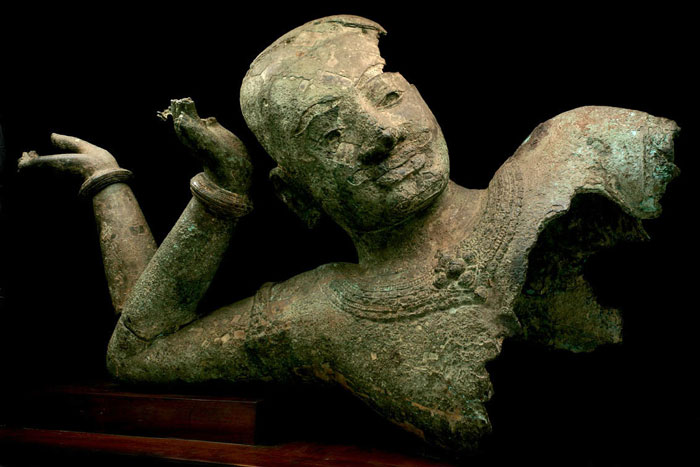
The National Museum was a good surprise. No pictures there either, but it's a bit like the British Museum in terms of seeing massive, ancient, religious statues. There are also people selling jasmine flowers on sticks to offer to the Buddha, so these are not just ancient relics. My favourite piece was the remains of a statue of Vishnu:

The divine hammock is implied.

The central market is a good place to bargain for cheap goods and dare your friends to eat deep-fried tarantula. Not a good place to eat tarantula though. Nowhere is. 

Visiting the genocide museum and killing fields is a weird experience. There is a gift shop at the museum, and survivors encourage you to pose for pictures with them. It reminded me of Alan Bennett's thoughts on visiting concentration camps (where do you have lunch?):
On a different level the discussion of the Holocaust in The History Boys relates to Hector’s dismay that Auschwitz has become just another station on the tourist trail, with Hector concerned about the proportion of reverence to prurience among the visitors. This recurs – and to my mind more harshly – in People, with the comment that there is ‘nowhere that is not visitable. That at least the Holocaust has taught us.’
But not visiting these places seems like an evasion. (By "these places" I mean the ones in Cambodia--I would not visit Auschwitz, although perhaps that can be done decently.) I didn't go to pay my respects but to learn (and because it was on the itinerary, of course). People have tried to pay their respects: at the museum by writing messages of hope, peace, anger, and religion; at the killings fields by leaving bracelets by the tree against which babies' heads were dashed. God. I think all of these attempts fail, and some are not even meant well (I'm thinking of the ones that say things like, "Don't worry, Pol Pot will burn in hell," as if that would make everything all right, and the ones that see mass torture and murder as an opportunity to proselytize). Other people have simply written their own names here. I'm not sure that they really qualify as people. The ones who mean well, though, at least have good hearts. As Wittgenstein said on a related subject (the attempt to say something about the absolute good): "it is a document of a tendency in the human mind which I personally cannot help respecting deeply and I would not for my life ridicule it." I wish I'd taken a picture of the graffiti. Others have:


A decent try

Less good

It wasn't until 1999 that the Khmer Rouge effectively ceased to exist. The whole country is scarred by the killing that has characterized its recent history, as well as the extreme poverty that many continue to live (and die) with. It's a disconcerting place to be a tourist. But knowledge seems better than ignorance, and tourist dollars seem better than none. So I think more people should come here. Just not in the Kevin from Ireland kind of way. What the right way is seems to me impossible to specify, but it would involve learning about the country and its people (which is fun, not a guilt-ridden chore), practicing responsible tourism, and helping where you can by buying from NGO-related groups and adults in need, without haggling too much over the price. Mostly it calls for sensitivity, I think, so that when you learn you change your behavior appropriately. But that's about as specific as I can get.