Showing posts with label anthropology. Show all posts

Monday, June 19, 2017

Witchcraft among the Azande

If you're interested in Peter Winch on understanding others, you might be interested in this documentary. Perhaps it's well known, but I only just found it:


And here's one on Evans-Pritchard:


I haven't watched either one yet, so can't guarantee their quality. 

Friday, January 23, 2015

Remarks on Frazer

Not Wittgenstein's remarks, but mine.

1. He has a way with words. This could almost be Fred Vargas:
The Mass of Saint Sécaire may be said only in a ruined or deserted church, where owls mope and hoot, where bats flit in the gloaming, where gypsies lodge of nights, and where toads squat under the desecrated altar. Thither the bad priest comes by night with his light o’ love, and at the first stroke of eleven he begins to mumble the mass backwards, and ends just as the clocks are knelling the midnight hour. His leman acts as clerk. The host he blesses is black and has three points; he consecrates no wine, but instead he drinks the water of a well into which the body of an unbaptized infant has been flung. He makes the sign of the cross, but it is on the ground and with his left foot. And many other things he does which no good Christian could look upon without being struck blind and deaf and dumb for the rest of his life. But the man for whom the mass is said withers away little by little, and nobody can say what is the matter with him; even the doctors can make nothing of it. They do not know that he is slowly dying of the Mass of Saint Sécaire.
 2. But his snobbery is incredible:
When we survey the existing races of mankind from Greenland to Tierra del Fuego, or from Scotland to Singapore, we observe that they are distinguished one from the other by a great variety of religions, and that these distinctions are not, so to speak, merely coterminous with the broad distinctions of race, but descend into the minuter subdivisions of states and commonwealths, nay, that they honeycomb the town, the village, and even the family, so that the surface of society all over the world is cracked and seamed, sapped and mined with rents and fissures and yawning crevasses opened up by the disintegrating influence of religious dissension. Yet when we have penetrated through these differences, which affect mainly the intelligent and thoughtful part of the community, we shall find underlying them all a solid stratum of intellectual agreement among the dull, the weak, the ignorant, and the superstitious, who constitute, unfortunately, the vast majority of mankind. One of the great achievements of the nineteenth century was to run shafts down into this low mental stratum in many parts of the world, and thus to discover its substantial identity everywhere. It is beneath our feet—and not very far beneath them—here in Europe at the present day, and it crops up on the surface in the heart of the Australian wilderness and wherever the advent of a higher civilisation has not crushed it under ground. This universal faith, this truly Catholic creed, is a belief in the efficacy of magic. While religious systems differ not only in different countries, but in the same country in different ages, the system of sympathetic magic remains everywhere and at all times substantially alike in its principles and practice. Among the ignorant and superstitious classes of modern Europe it is very much what it was thousands of years ago in Egypt and India, and what it now is among the lowest savages surviving in the remotest corners of the world.
Frazer is nakedly racist and what he thinks of the "savages" of Australia he thinks also of the lower classes of England and elsewhere. I don't mean to dig him up just to criticize him for not having been more enlightened, but it seems to me that Wittgenstein's response to Frazer has an interesting and important political aspect. In locating the magical impulse within us Wittgenstein denies this kind of racism and snobbery. He runs shafts down into himself, and invites his readers to do the same, not into the "low mental stratum" of other people or places. Tat tvam asi. This activity is confessional but also radically democratic or egalitarian.

(This probably is not an earthshaking revelation but I need to return to my old "it's only a blog" mentality or I'll post nothing at all.)         

Thursday, August 7, 2014

The Burry Man

I haven't blogged for a while and probably won't for a week or two because I'm traveling. I don't have much to say right now, either, but here's something that caught my eye. A surprising number of people I follow on Twitter are Scottish and one of them, Ian Rankin, tweeted this story today. According to the BBC:
The Burryman is as he sounds, a man made from burs. Dressed head to toe in the spiked and painful seeds, he parades around Queensferry on the second Friday in August every year. He is accompanied by two aides who help him with his difficult task and a number of other helpers who make up the rest of the entourage. He cannot move his arms to his sides, walk particularly well or even sit down, yet he tours Queensferry for the whole day. The small whiskies the Burryman receives throughout his tour help fortify him in his task and also offers a way for the public to show their gratitude. Even with the pain and discomfort caused by the outfit the Burryman tradition lives on.
The origin of the practice is obscure, but it is at least several hundred years old. One theory has it as a punning celebration of Queensferry becoming a burgh, others as much older and pagan. Not only is the costume painful, it is so hot that it is hard for the man in it not to faint. He is supported by others so he doesn't collapse. But he is also decorated with flowers and the occasion is merry. What would Frazer have made of this? What would Wittgenstein say?

Embedded image permalink

Of course I don't know, and it doesn't particularly matter. It does, though, seem both an intrinsically interesting case and a good way to try out some of the ideas expressed in Wittgenstein's remarks on Frazer. John Nicol (@johnjnicol) was the Burryman for thirteen years and says it baffled him. He also describes the job as an honour and the tradition as a mystery, which he regards as important. I think he's right, and this idea (that the mysteriousness of this kind of customs is part of the reason for their existence) is a Wittgensteinian one. The mystery means we can try out various theories, or rather trot them out, since we have nothing much against which to test them. In doing so we bring what we know about human nature and experience to bear on the facts before us, the phenomenon in question. And then it almost doesn't matter whether our theories are right or wrong. What matters, we might say, is what we recall of human nature and experience, and what we see in the custom itself: individual suffering and sacrifice, hidden (yet obvious) suffering, public and communal celebration, fertility, whisky, and so on. It's almost like a Rorschach test, but not quite. Fascinating, though. And creepy.

Presumably Wittgenstein might object that we should not trot out theories to try to explain the Burry Man. Rather, we just need to set out all the facts in the right way and no explanation will be necessary. (At least he might say that. I don't think he's committed to saying this in every case.) This reminds me of the idea that in ethics there is nothing to be said. But that's something to explore another time.

Tuesday, June 17, 2014

All rites are of this kind

I mentioned that Brian Clack's book on Wittgenstein, Frazer and Religion is very good but I didn't really say what is good about it. Very briefly, almost everyone (at least up until the time when this book came out) reads Wittgenstein's remarks on Frazer as putting forward an expressivist view, according to which magical and religious practices are not intended to serve an instrumental purpose but rather they express attitudes and feelings. Against this, Brian argues very persuasively that some are expressive and some are instrumental:
I have, time and again in this book, emphasized that this is where the true difference between Wittgenstei n and Frazer lies: not in the latter’s belief that rites aim to achieve some end, but in the fact that he contends that such actions come about through a process of reasoning akin to hypothesis-forming and experimentation. It is the gratuitousness of the reasons Frazer gives for primitive observances – so ubiquitous in The Golden Bough – which stands in such stark contrast to the conception of natural piety. (p. 159)
Earlier on the same page he writes:
Thus, Frazer looks for reasons why the oak was so venerated (locating this in its association with the sky, the rain, the thunder, and, consequently, with Zeus), whereas Wittgenstein stresses the non-ratiocinative nature of this worship (‘no reason’).
Frank Cioffi makes a similar point on pp. 155-156 of his book Wittgenstein on Freud and Frazer. Cioffi writes:
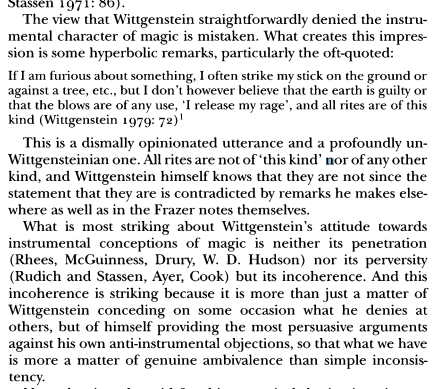

I wonder whether the kind that Wittgenstein had in mind (when he said that all rites are of "this kind") has been misunderstood. He obviously does not mean that all rites are ways of releasing rage (and no one thinks he means this). But must he be saying that all rites are ways of releasing some emotion? One thing to note about his reference to releasing his rage is that it is in quotation marks, presumably because this is an expression we use (and which he is quoting) but also because it is a figure of speech. Rage is not something that one can literally release. So he has not told us what kind of thing rites are, only given something figurative to associate or compare them with. Another thing to note is that this seemingly expressivist point is made in contrast to two alternatives: I might believe that the earth is guilty and deserves punishment or I might believe that beating the earth will be of some use. As Brian points out, Wittgenstein is not rejecting instrumentalism here. If he were then the bit about the earth's being guilty would not belong: punishing the guilty is not typically understood instrumentally. The contrast that Wittgenstein makes is not between instrumentalism and expressivism but between behavior based on belief and behavior that is more primal, which means basically behavior that is not based on belief or ratiocination. Such behavior can still be intended to bring something about, but it is based on or starts with some feeling. In short, it is not science. For example, if I try to kill my enemy by sticking pins in a doll then I am trying to bring something about, but on the basis of a sense that what is done to the likeness of my enemy must also be done to him. We can call this sense a belief if we like, but it isn't one that I have because I have thought about it or on the basis of observation. It is just the kind of thing that human beings naturally seem to think (or 'think'). If I thought about it for a moment I would see right away that it was groundless. Wittgenstein's point, I take it, is that it is with such groundless beliefs or senses or instincts that ritual begins. This is the kind of thing they are.  

Thursday, June 12, 2014

Casting stones

A weird feature of scholarly work is that you pretty much have to disagree with people in order to count as having something to say. This means at least half-hoping that other people have got things wrong, which really one shouldn't hope for at all.

I'm re-reading Brian Clack's Wittgenstein, Frazer and Religion hoping both to learn from it (which I certainly am) and to find something I can disagree with or perhaps add to. I'd forgotten what a good book it is, but here's something that I think I might disagree with:
An Abyssinian king, the Alfai, is held to be able to cast down rain, and:
if he disappoints the people's expectation and a great drought arises in the land, the Alfai is stoned to death, and his nearest relations are obliged to cast the first stone at him. (Frazer;1922: 107)
[...] The case of the Alfai [...] suffices to show that the expressive theory cannot be universally applied, and that some ritualists really do think that the rain-king can make the heavens open. (Clack, p. 33)
I don't intend to defend the expressive theory (which says that rituals, etc. are not instrumental but expressive of feelings or attitudes), but I don't think this case shows what Brian says it shows, at least not in a straightforward way. Before I get to my point I should mention that he has a long footnote at this point, in which he says both that, "Wittgenstein is adamant that primitive peoples do not believe that rain-makers can alter the course of the weather, or that magicians have any special powers whatsoever," and that, "It is remarkable that Wittgenstein does not think for one moment that people could believe that a ruler has supernatural powers" (Clack, p. 178, n. 1). It is these remarks that I disagree with more than the one I first quoted.

The (most) relevant passage in Wittgenstein's remarks is this:
It is, of course, not so that the people believe that the ruler has these powers [to control the course of nature], and the ruler knows very well that he doesn't have them, or can only fail to know it if he is an imbecile or a fool. But the notion of his power is, of course, adapted in such a way that it can harmonize with experience--the people's as well as his own. That some hypocrisy thereby plays a role is true only insofar as it generally lies close at hand with most things people do. (Philosophical Occasions, p. 139)
It seems at least possible that Wittgenstein is denying the conjunction of the people's believing that the king has these powers and the king's either knowing the contrary or else being weak-headed or foolish. If everyone involved believes that the king has supernatural powers (without the king's being feeble-minded) then, on this reading, Wittgenstein is right. This reading seems quite natural to me and certainly more charitable than the one that leads to the remarkable conclusion. It also fits the quotation from Culture and Value that Brian discusses on pp. 113-114, in which Wittgenstein writes that, "Men have believed that they could make rain."

What, though, about the belief that the Alfai can make the heavens open? Do the ritualists believe this? And would their doing so prove Wittgenstein wrong? Certainly the Alfai is held responsible for any great drought. Must he therefore be believed to be able to end the drought? If he were able to make it rain why wouldn't he do so in order to avoid a horrible death? Haven't the Abyssinians thought of this? Did no about-to-be-stoned Alfai ever make this case? Surely either they did and, remarkably, it made no difference to what happened or, remarkably, it never came up. Either way we are some distance from having clear evidence of straightforward ignorance of fact on the part of the Abyssinians concerned. If they say and think that "the Alfai can make it rain" and then kill him if there's a drought then in some sense they certainly believe that he has supernatural powers. But what this sense is is not a simple matter. That 'belief' does not refer to just one phenomenon is a point that Brian makes very well in chapter 4 (see p. 49 especially).

Perhaps an analogy will help me make my point. Is Groundhog Day (not the movie) bad science? It isn't good science, of course, but it needn't be regarded as science at all. Do the people involved really believe that the movements of a groundhog can predict the weather? Perhaps some do. But surely most don't. Still, many people pay attention to what the groundhog does. Why? What are they thinking? I doubt that most of them are thinking much at all. Not that they are stupid people, but that the whole exercise is not an intellectual one at all. It's a ritual. It's just what people do. And something similar might well go for the case of the Alfai. Much more is at stake there, of course, but that doesn't mean it must be more intellectual or scientific than Groundhog Day. It just means that more is at stake. Why would people stone a man to death without thinking through the costs and the benefits? Perhaps the people they have been raised to defer to insist that this is the right thing to do. (Perhaps even the Alfai himself insists on this.) Perhaps they sense that sacrifice is bound to pay off. We are far from immune to such thinking today, and even if it is wrong it is not only the stupid and the insane who go in for it. And that, I take it, is the kind of point that Wittgenstein means to make.

Halfway through the book comes the second point I disagree with Brian on. At the bottom of p. 92 he says that, "Wittgenstein's prohibition on explanation seems [...] a rather bizarre one, informed only by personal preference." Actually, I probably agree as long as we emphasize the word 'seems', but I don't think that Wittgenstein's "prohibition" actually is bizarre. It strikes me as being very similar to some of his views on aesthetics. Understanding what is good about a work of art means something like being able to articulate its good qualities, and perhaps to lead someone else to appreciate it too. It does not mean knowing about any causal processes that result in this or that event in the brain. Perhaps there can be scientific explanations of why we like this or that, but these are not what literary criticism, art appreciation, music appreciation, etc. are concerned with. You could argue that they should be, but that's a different matter. Wittgenstein's interest in Frazer's work, like Frazer's too, I think, is what you might call aesthetic. Not in the sense that he finds the practices described in the Golden Bough (merely) charming, but in the sense that they are fascinating expressions of humanity. Fascinating partly because of the mysterious non-triviality that draws people to such behavior, and partly because we find that this very weirdness resonates with us too, revealing something about ourselves and humanity in general. Knowing about any underlying history or biology would be not worthless but something else.

Tuesday, June 10, 2014

Because it is terrible

In the Remarks on Frazer (pp. 2-3) Wittgenstein writes:
     Frazer says it is very difficult to discover the error in magic and this is why it persists for so long—because, for example, a ceremony which is supposed to bring rain is sure to appear effective sooner or later.
     But then it is queer that people do not notice sooner that it does rain sooner or later anyway.
     I think one reason why the attempt to find an explanation is wrong is that we have only to put together in the right way what we know, without adding anything, and the satisfaction we are trying to get from the explanation comes of itself.
     And here the explanation is not what satisfies us anyway. When Frazer begins by telling us the story of the King of the Wood of Nemi, he does this in a tone which shows that something strange and terrible is happening here.  And that is the answer to the question “why is this happening?” : Because it is terrible.  In other words, what strikes us in this course of events as terrible, impressive, horrible, tragic, &c., anything but trivial and insignificant, that is what gave birth to them. 
Here Wittgenstein implies that the attempt to find an explanation of magical behavior is wrong but then almost immediately appears to offer an explanation of his own. We could respond to this seeming hypocrisy by saying that these are just notes, and they are, but this is from the early part of the book, not the later part that consists of what Rush Rhees calls "rough notes", and this material was dictated to a typist, so it isn't just notes.

It might help to look at the original German: das hat diesen Vorgang ins leben gerufen--that called this procedure [Klagge and Nordmann have 'incident'] into life. I think we have to take this as something other than a causal hypothesis. (This is confirmed by remarks on p. 8 and p. 9.) Wittgenstein wants to understand not why a particular form of behavior happened to begin but why it persisted, why its first occurrence was the beginning of something that continued to occur. And his answer is: because it is something that strikes human beings as highly significant, as not in the least bedeutungslos. This is not an hypothesis but something we know, because we feel it too. And it is not an explanation of anything, but it provides the satisfaction that we (mistakenly) look for in explanations. All that we need to do in such cases is to arrange what we know in the right way and then allow the facts to strike us, allow ourselves to feel in response to these facts (and their arrangement, but the relevant arrangement just is, I take it, the one that makes us respond in this way). Then, I almost wrote, there is no mystery. But of course there is a mystery. The mystery, though, is not why people would behave in this way. The mystery is in the behavior and is the answer to our question. People do this sort of thing because it is mysterious or, perhaps better, powerfully uncanny. They aren't trying to be obscure, after all. They want meaning, and this kind of thing provides a powerful sense of meaning.

Wittgenstein rejects as inevitably unsatisfactory attempts to explain magic and religion. Religious actions, he writes, can be 'explained' and cannot be explained (p. 4). What he offers, I take it, is an 'explanation' but not an explanation. It appeals to an inclination in ourselves, an inclination that we might call the ceremonial or ritualistic in contrast to the animal:
one might begin a book on anthropology in this way : When we watch the life and behavior of men all over the earth we see that apart from what we might call animal activities, taking food &c., &c., men also carry out actions that bear a peculiar character and might be called ritualistic. (p. 7)         
(This is reminiscent of the distinction in the Lecture on Ethics between the trivial/relative and the ethical/absolute. Nonsensicality belongs to the essence of ethical expressions, just as inexplicability belongs to the essence of magical actions. Indeed Wittgenstein identifies the ethical and the religious in the Lecture on Ethics (and says that ethics is about the meaning of life) and the magical and the religious (which are also about meaning) in the notes on Frazer. I don't mean that what he said about ethics in 1929 is exactly what he said about magic in 1931, but there are connections. And I'm not saying that they are not identical either. I need to read and think about this more.)

It is in this sense that "Frazer is much more savage than most of his savages" (p. 8), because Frazer is closer to being stuck in animal mode, understanding magic only as an ineffective way to get food, etc.  But even he uses words like 'ghost' in his explanations of "savage" behavior. He is still human, after all, despite his modernity and his Englishness. And so he is still somewhat in touch with what is frightening and terrible in the stories he relates, qualities they acquire from the evidence:
from the thought of man and his past, from the strangeness of what I see in myself and in others, what I have seen and have heard. (p. 18)    
I should have a conclusion here but I'd rather just repeat "the strangeness of what I see in myself" to fade. And to connect this with Wittgenstein's famous earlier remark to Paul Engelmann:
And this is how it is: if one does not endeavor to express the inexpressible, then nothing gets lost. But the inexpressible will be — inexpressibly — contained in what has been expressed. 
A good description of the facts of the case concerning the King of the Wood of Nemi loses nothing but contains the inexpressibly terrible. Because the facts themselves are terrible. Not in some absolute way, but to us. As long, that is, as we are sufficiently strange (i.e. normal).

Sunday, October 9, 2011

The Wodaabe

Wittgenstein's Tractatus makes me think of a universe of possibilities, pictured as innumerable Cartesian axes, one for all possible colors, one for all possible notes, one for all possible degrees of hardness or softness, and so on. Our own world, the actual or real world, is just some combination of coordinates on these axes. It could be otherwise. Wittgenstein is suspicious of the idea that we can in any way map or chart the possibilities though. Kant wanted to investigate what computes and what does not compute in order to discover the workings of the mind, conceived as a sort of data processor. Wittgenstein suggests that to think you can see the limits of thought is to imagine that you can see beyond them. I suppose we might think of this as applying Kantian humility to Kantianism itself.

It isn't clear what can be imagined, or conceived, or understood, or found to make sense. Nor is it clear whether these are all different things. The uncanny, the strange, is not easy to see clearly and distinctly. But the wealth of possibility is beautiful, and the thought of contingency can be exciting as well as frightening. Things don't have to be this way. It ain't necessarily so. Which can be scary (I always think of Sartre's nausea) and amazing (I think of Chesterton's view of nature as a miracle). Roughly speaking, it's cool.

The relevance of possibility to philosophy makes literature relevant, but also anthropology. Anything that can teach us differences. And this is one reason why I recommend Michael Palin's series Sahara, especially the episode (I think it's number 3) in which he encounters the Wodaabe:
Despite hard lives and harsh conditions, the Wodaabe are by no means grey or ground down. Celebration, dance and the pursuit of beauty are important parts of their everyday life and all three come together in the Gerewol, an extraordinary Fulani ritual that will be part of their Cure Salée celebrations. The young, unmarried men spend hours making themselves look beautiful, painting their faces red, highlighting their eyes with white lines and their lips with black powder. The effect is to make them look feminine and prematurely aged at the same time. The display is combined with a formal dance, at which these richly adorned men vie with each other for the favours of the young girls. The girls make the choice. It's free and open, and whilst it does not have to end in marriage, it does have to end in a night together.
It's one of the strangest things I've ever seen. Perhaps it won't seem so strange if you think of the phenomenon as that of young men making themselves beautiful. Don't transvestites try to do that? But these are not transvestites. They are making themselves look both feminine and prematurely aged in order to make themselves more attractive to women. The idea is strange, and the sight of it is uncanny too.


And now I find that Werner Herzog has made a film about these people, which is probably better than Palin's: