It's hard to say what the word 'literally' means. When I was in graduate school someone suggested that the literal meaning of a word is its most common use, and Wikipedia echoes this in part. But I suspect the most common use of the word 'literal' itself is incorrect and therefore not literal. If someone says "It was literally raining cats and dogs" they (probably) mean it was raining as much as it does when people typically say "It is raining cats and dogs." They don't mean that it was literally raining cats and dogs, i.e. that animals are falling from the sky. Literal meaning is better understood, I think, as non-figurative rather than normal or common meaning.
Why should anybody care? I suppose because of the people who say we should read the Bible and the US Constitution (etc.) literally. It's a political issue, in other words, since literalism is generally used to support conservative views. Against those who emphasize the (supposedly) loving spirit of the Bible or the liberal (and, e.g., supposedly pro-choice) spirit of the Constitution, literalists will insist on following the letter of the law. Along with rights to guns and no rights for gays, this leads to such additional benefits as the denial of evolution. So it's a big deal.
Having said that, debates about constitutional interpretation tend not to focus on literalism but on such theories or positions as originalism. For a response to that position I defer to Sean Wilson. One problem with taking the Constitution literally is that doing so doesn't give people what they want. The House of Representatives is not literally a house (not only is it not a place inhabited by a family, it is not a building at all but a group of people), the right to bear arms is not literally just a right to carry weapons but to use them, and talk of rights is hard to take literally at all--what is a literal right? Words like 'rights' don't have a clear, non-figurative meaning. When people say they believe in taking the Constitution literally they mean that they support something like originalism, which is clearly a kind of interpretation, one way among a plurality of ways of taking the Constitution. In this case, then, literalism does not get us away from interpretation. There is no option but to interpret (or ignore) the Constitution in one way or another.
Something similar goes for the Bible too. No sane person would deny that there is figurative language in the Bible. People who say they want to take the text literally don't really mean that. They mean they want to avoid over-interpretation (who doesn't?) and that they believe other people are guilty of such over-interpretation. This position faces problems, such as how to deal with the apparent contradictions in the Bible and what it could mean for the Earth and sun (and everything else) to have been created in six literal days, but these are not necessarily insurmountable. The point I want to make is that Biblical "literalists" don't actually take the Bible literally (i.e. completely non-figuratively). They support a particular kind of interpretation.
Does it follow that no utterances have a literal meaning, that all call for interpretation? No. However unlikely it might be, I could mean "It's raining cats and dogs" literally. Do utterances always need interpretation? No. They always need to be understood (if they are to be understood) but nothing is gained by calling understanding interpretation. Does understanding always take place within a context? Of course. Does this context matter to the meanings of words? Of course. Is understanding therefore always in fact a case of interpretation? No.
What about literature? Does a novel or poem have a literal meaning? I don't see why we shouldn't say so. Some literature is more figurative, some less so. "I caught this morning morning's minion" should not be taken literally: he wasn't out catching birds. But is he talking about a literal falcon or is this a metaphor? Or both? These seem like reasonable questions. It is useful to be able to distinguish a literal from a figurative reading, so why not allow for such distinctions? Is the literal reading not an interpretation? It is a way of taking the poem. And in the case of this particular poem, which is full of figurative language, it seems that any way of taking it is going to be an interpretation. But I don't see that anything is gained by saying that all takings are interpretations. If you recite a poem about an old man from Nantucket who has an unfortunate episode with a bucket, and I laugh then I am not interpreting your poem as funny. I do, I suppose, take it to be funny, but even that is a bit of an odd way to put the point. I just react.
Now, it might be objected that I don't just react. I react within a certain context, which has historical, political, social, etc. aspects. That's true. But it's also true that I react within a certain physical context: I am breathing air near the surface of the planet, etc. It's still true that I just react because "just react" means react-without-having-to-do-any-such-thing-as-stop-and-think. It does not mean that I react and do nothing else whatsoever, including existing within various kinds of contexts. Nor does it deny that these contexts affect the way (or fact that) I react. We shouldn't take the word 'just' here literally.
Friday, April 4, 2014

Tuesday, April 1, 2014
Thanks
From the acknowledgements in my new book:
I hope I'm right that dmf prefers anonymity, but thanks to you too.I have many people to thank for what is good and none to blame (except myself) for what is bad in this book. I should first thank Jon Woronoff for inviting me to engage in what has been a great exercise in re-reading and trying to articulate clearly thoughts that I have, in some cases, never had to write out before now. These thoughts have been shaped mostly by Wittgenstein himself of course, but my reading of Wittgenstein has been inspired and influenced by a series of teachers. My first philosophy teachers, Edmund Prestwich and Geoff Willis, were not Wittgensteinians but did inspire in me a love of the subject. I was really introduced to Wittgenstein’s work by my friend Jane Davies, who studied his work formally with Stephen Mulhall. As a graduate student at Swansea I learned from Rush Rhees, my supervisor D. Z. Phillips, and my friend Catherine Gardner. I was also introduced there to the work of Cora Diamond, who was later my dissertation adviser at the University of Virginia. Since then, in developing the understanding that was reflected in the first edition of this book, I benefited from discussions with Bill Brenner, Lars Hertzberg, Tim Kjeldsen, Stuart Mirsky, Guenter Trendler, Kirby Urner, and T. P. Uschanov. That was almost a decade ago. In the intervening time I have continued to learn from some of the people I named above and from some new people, notably the members of the Virginia Wittgenstein Workshop started by James C. Klagge, from commenters on my blog, especially Reshef Agam-Segal, Philip Cartwright, Joshua Kortbein, and Matthew Pianalto, and from my students at the Virginia Military Institute. I am grateful to them all.
Saturday, March 29, 2014
April fool's day
According to amazon, this is coming out on Tuesday. I'm sorry it's so expensive, but I guess this is the version for libraries. Hopefully a cheaper paperback will follow.
It's longer and more up-to-date (bibliography-wise) than the previous edition, and hopefully better too. (I'll post the acknowledgements here next week.) I like the cover.
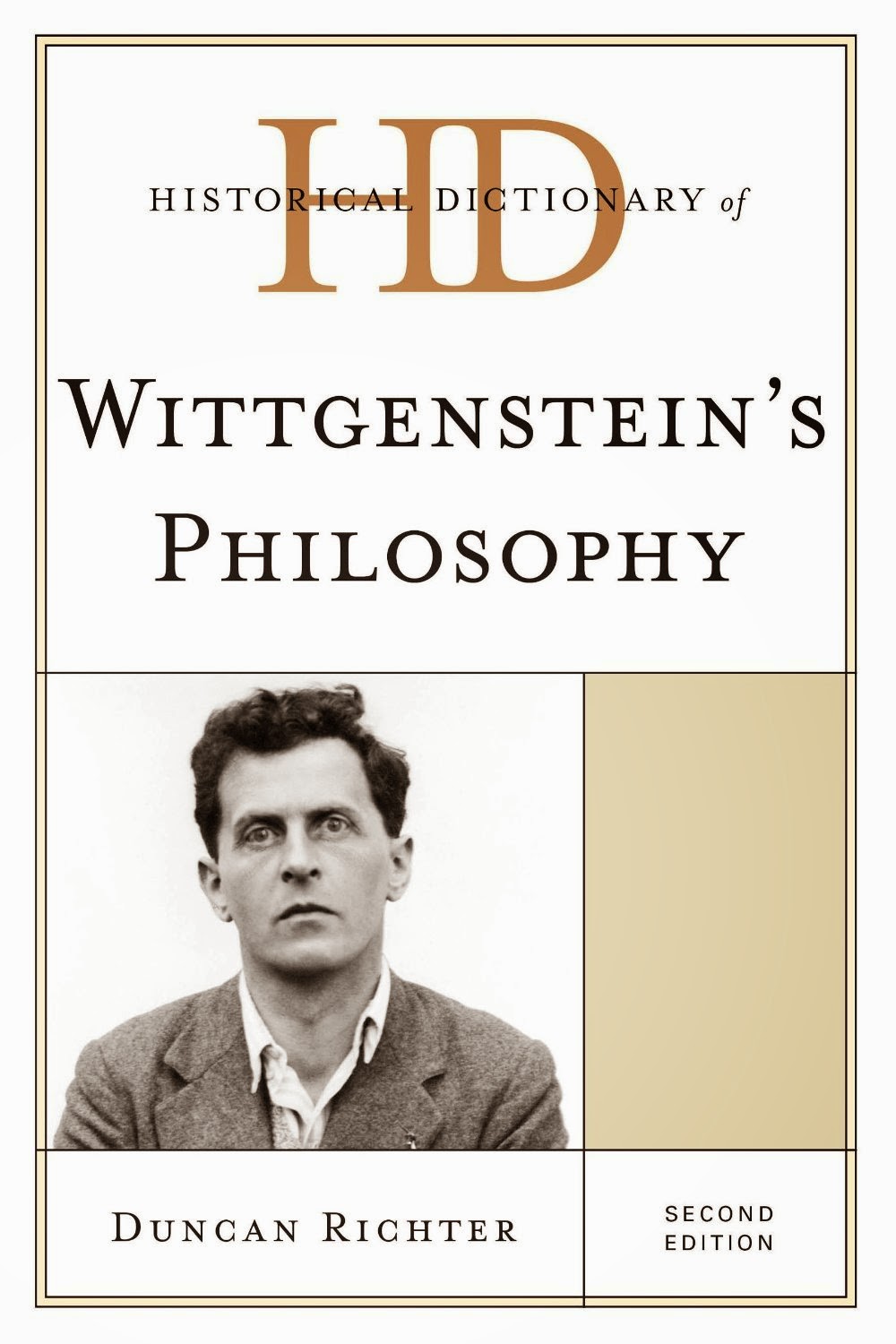
It's longer and more up-to-date (bibliography-wise) than the previous edition, and hopefully better too. (I'll post the acknowledgements here next week.) I like the cover.
Thursday, March 27, 2014
Is There a Text in This Class?
A little late, I finally read Stanley Fish's famous essay. I don't have a lot to say about it, but I think it's interesting as an example of what ideas like Wittgenstein's look like when carried over into another realm. For what it's worth, here's a kind of summary plus criticism.
Fish's main point, as I see it, is that meaning depends on context. I agree.
He also says that:
But in understanding the relevant context I am not assigning a shape to someone's utterance, nor giving it a meaning. As Fish himself says, "To be in a situation is to see the words, these or any other, as already meaningful." These words in this situation already mean whatever they mean. There is no assigning or shaping that I as the speaker or the listener can do to them. The relevant purposes and concerns, as Fish says, are already there.
So we don't (Fish says, and I agree) always interpret utterances. Sometimes we do and sometimes we don't:
In short, I think I agree with Fish.
UPDATE: For more on Fish see here (where I still think I agree with Fish but explain why I'm not entirely happy with some things he says) and here (where I finally lose patience). In other words, "I agree with Fish" is by no means my last word on the subject. And if you're interested in what I've written here then you'll probably be interested in what I've written in those other two posts.
Fish's main point, as I see it, is that meaning depends on context. I agree.
He also says that:
one hears an utterance within, and not as preliminary to determining, a knowledge of its purposes and concerns, and that to so hear it is already to have assigned it a shape and given it a meaning.This seems unfortunate to me, and might be one source of the idea that individuals make meanings, an idea that I take it Fish would reject. [Update: It turns out I was quite wrong about this.] One thing that's unfortunate about it is that one surely does not in any clear sense hear an utterance within a knowledge of its purposes and concerns. I don't (necessarily) already know the purpose of your utterance before you have finished uttering it. A few pages later Fish goes so far as to say of someone that, "her words will only be intelligible if [her audience] already has the knowledge they are supposed to convey." It's pretty obvious that Fish does not mean what he is saying. That is, he does not mean that if I ask you what time it is then I cannot understand what you say unless I already know what time it is. What he means is that I will not understand what you say unless I understand the context well enough to know what kind of thing you are going to say. If you say "six thirty" then in certain circumstances I will know that you mean breakfast time, in others I will know that you are giving me the score in a football game, and so on. If I had no idea what the context was then I could not tell what you meant, if anything.
But in understanding the relevant context I am not assigning a shape to someone's utterance, nor giving it a meaning. As Fish himself says, "To be in a situation is to see the words, these or any other, as already meaningful." These words in this situation already mean whatever they mean. There is no assigning or shaping that I as the speaker or the listener can do to them. The relevant purposes and concerns, as Fish says, are already there.
So we don't (Fish says, and I agree) always interpret utterances. Sometimes we do and sometimes we don't:
I am not saying that one is never in the position of having to self-consciously figure out what an utterance means.This self-conscious figuring out is, I take it, the normal sense of 'interpreting.' Fish does not deny that we sometimes have to interpret utterances, but he points this out because he is so far from saying that we always do. He explicitly rejects the assumption that there is always:
a distance between one's receiving of an utterance and the determination of its meaning -- a kind of dead space when one has only the words and then faces the task of construing them.I think that what Fish means is perfectly right, he just doesn't always express himself perfectly (who does?). This is a problem with his use of the word 'assumption.' Words that are uttered, he says, "are immediately heard within a set of assumptions about the direction from which they could possibly be coming." Assumption is an act, though, and assumptions are things that we make. The phenomenon that Fish is describing is more passive than that. There is no dead space in which one faces the task of making the necessary assumptions before trying to understand, or immediately--the assumptions having been made--understanding, someone else's words. There is something like assuming going on here, and we can call it assuming if we like, but it is not consciously chosen. Fish fairly clearly recognizes this. At one point he refers to one individual's assumption of what the concerns motivating someone's question could possibly be, but elsewhere he talks about "the understood practices and assumptions of the institution" (not of the individual) and of people's being possessed by "a structure of assumptions, of practices," which I think is closer to what he means and should mean.
In short, I think I agree with Fish.
UPDATE: For more on Fish see here (where I still think I agree with Fish but explain why I'm not entirely happy with some things he says) and here (where I finally lose patience). In other words, "I agree with Fish" is by no means my last word on the subject. And if you're interested in what I've written here then you'll probably be interested in what I've written in those other two posts.
Wednesday, March 26, 2014
Facebook failures
The line between what belongs on a blog and what belongs on Facebook can be hard to discern, but I've been neglecting this place a bit lately and some things I have posted to Facebook have been more or less ignored, so I'll try them here. One's an essay by Schopenhauer, one's a New York Times story that raises issues about politics, religion, and psychology, and one is just a cool video (but, as I recall, it is very cool).
Here's Schopenhauer, which I found via Brain Pickings, although now I suspect I have read it before. His views are similar to Orwell's, and I wonder whether Wittgenstein read this essay. Here's the bit that stood out to me:
Here's Schopenhauer, which I found via Brain Pickings, although now I suspect I have read it before. His views are similar to Orwell's, and I wonder whether Wittgenstein read this essay. Here's the bit that stood out to me:
[...] Goethe’s naïve poetry is incomparably greater than Schiller’s rhetoric. It is this, again, that makes many popular songs so affecting. As in architecture an excess of decoration is to be avoided, so in the art of literature a writer must guard against all rhetorical finery, all useless amplification, and all superfluity of expression in general; in a word, he must strive after chastity of style. Every word that can be spared is hurtful if it remains. The law of simplicity and naïveté holds good of all fine art; for it is quite possible to be at once simple and sublime.Here's the Times story. Unfortunately it's presented as a story about those crazy foreigners, but there's far more to it than that. This will hopefully give a sense of what it's about:
These days, when neak ta [local guardian spirits] appear on the factory floor — inducing mass faintings among workers and shouting commands at managers — they are helping the cause of Cambodia’s largely young, female and rural factory workforce by registering a kind of bodily objection to the harsh daily regimen of industrial capitalism: few days off; a hard bed in a wooden barracks; meager meals of rice and a mystery curry, hastily scarfed down between shifts. These voices from beyond are speaking up for collective bargaining in the here and now, expressing grievances much like the workers’ own: a feeling that they are being exploited by forces beyond their control, that the terms of factory labor somehow violate an older, fairer moral economy.Finally, here's the time-lapse video of Earth as seen from space:
Tuesday, March 25, 2014
immanentforms
Via Reshef I see that someone I know (who appears to want to remain anonymous) has a blog.
Wednesday, March 19, 2014
Russian films
In case you care about this sort of thing but missed it, Dave Maier has a very useful-looking review of a bunch of Russian movies over at 3 Quarks Daily. And if you like that, see also his previous article on (mostly) Japanese movies.
Subscribe to:
Posts (Atom)